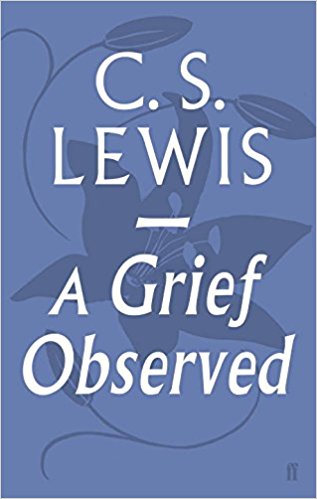
A Grief Observed – by C.S. Lewis

6 10 2017

At 64 pages I imagined I’d fly through this, even if it was non-fiction. Nope, 10 days!

Essentially these four chapters are Lewis’ scribblings in his notepad after his wife, Joy, passed away. Sometimes it’s a sheer expression of grief, others get more theological.

He actually originally published it anonymously and so the initials with which he refers to other people are all different – I know “H” refers to his wife, but not any of the others!

Some ideas he raises are so interesting. He suggests that some qualities we consider bad, God has, and that they’re not bad, but we only see them as bad because of our human narrow view of the world. C.S. Lewis is definitely one person I have at my dream dinner party – he’s said some quite controversial things in his time and I want to talk much further!

He gives a analogy of grief as going round in circles, and daring to hope that he might be on a spiral, and which direction he is going on it. Such a clever man.

Again there are some great one-liners in here too, my favourite being “What do people mean when they say ‘I am not afraid of God because I know He is good.’? Have they never been to a dentist?”

I very much enjoyed his use of the plural of cul de sac, “culs de sac”, which is so much more pleasing than what we’d assume “cul de sacs”. But that’s a bit of an aside.

I also loved his reference to “when you have learned to do quadratics and enjoy doing them” – because eventually everyone should enjoy them 😀


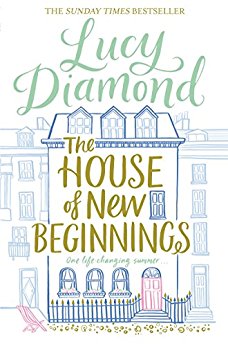
The House of New Beginnings – by Lucy Diamond

25 09 2017

I visited a friend at the start of the month and she’d just finished this book and so passed it on to me. I already had a large reading pile, but was interested and have *some* manners, so after I’d finished my current book, and a very short related book after, I gave this one a go.

It’s unashamedly chick lit, but I don’t think that’s a bad thing! Essentially the book is about the residents of the five flats in Seaview House in Brighton.

  • Flat one is Jo, and her teenage daughter, Bea. Jo becomes quite unwell early on and Bea has a damaged relationship with her Dad that needs sorting out.
  • Flat two is Rosa. She’s recently moved down from London after finding out her boyfriend was not all he seemed and so is looking for a fresh start.
  • Flat three is Georgie and Simon. Simon’s just got a great architect job so he’s moved down from Yorkshire and Georgie has come with him, without much sense of purpose.
  • Flat four is Charlotte. She lost her baby daughter recently, after which her marriage broke down and so she has moved to Brighton to get away from all that.
  • Flat five is Margot. She’s an old, frail lady who’s likes money to be spent “unwisely” and to talk about her impending death as some old ladies enjoy doing!

The book begins as Georgie and Simon move in, and gradually you see these women trying to suss out what their life in Brighton is going to be. They gradually get to know each other too and we just spend time following the highs and lows with them over their first summer in the house.

It’s an easy read and pretty feel good 🙂


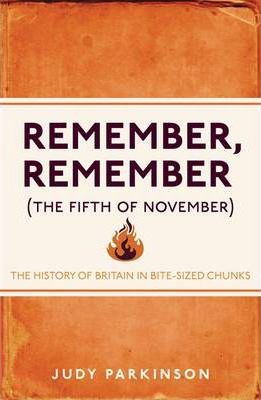
Remember, Remember (The fifth of November) – by Judy Parkinson

11 09 2017

I hated history at school, I liked the Victorians and Tudors, probably because of their pretty dresses, but the Romans never stuck, nor did much else.

This is my sort of history book. No article in it is more than 250 words. It opens with a timeline and a list of monarchs, and then from the Roman Invasion around 2000 years ago, up until the end of the Second World War, each significant historical item has one page, and one page only to be explained. It was so easy to read, you could binge or just read a page or two depending what time you had. Bite-sized; perfect.

I’ve had this on my shelf for a while and occasionally used it for reference, but it was great to just read it through over a couple of days (especially having just read some historical fiction and seeing how much of that came up) and get a good overview of the history of my country!


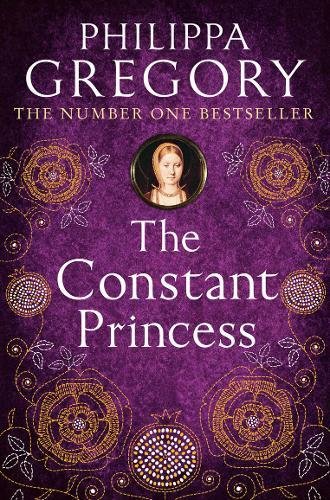
The Constant Princess – by Philippa Gregory

11 09 2017

I aimed to read a load of books on holiday, but I realised that when I was a child I think I got so much reading done on the long car journeys; now it’s me driving, I’ve lost all that reading time!

I’d been thinking about trying a Philippa Gregory book for a while, and always liked the Tudors, so when it came to topping up an Amazon order to get free delivery I tacked this one on my basket.

She’s written so many books, but helpfully has put a suggested reading order together so you get a chronological flow.
https://www.facebook.com/notes/philippa-gregory/novels-in-reading-order/759503054092544
It may look like I’ve started in the middle, but I decided to go for the one about the first of Henry VIII’s wives, Katherine of Aragon. That said, once I was reading it I kinda wished I’d started one book further back on Henry VII’s wife, but I imagine I’d work my way right back if I did that – maybe one day I will!

We start with Catalina age five in Spain to get a bit of background – at this point she’s already betrothed to Henry VII’s oldest son Arthur (Henry VIII’s older brother), and then quite quickly skip forward nine years to her arrival in England for her wedding to the Prince of Wales.

It’s hard to know how much to share without a spoiler alert because this is based on history – we all know that Arthur died before he made it to the throne because we know there was never a Tudor King Arthur! That said, there’s a lot to read about their relationship, and then of course how she ended up to be married to his younger brother later on.

I’d be fascinated to know where the line is between fact and artistic licence in these books. They are said to be very well researched, but how far does that go? Did a very young Prince Henry really walk her down the aisle to Arthur? Probably. Did Henry VII really storm in her bedroom to check she was attractive when she first arrived to marry his son? Who knows! All sorts of questions arise!

I really enjoyed this and can see me at some point working my way through the series, just got lots of other books to get through in the mean time!


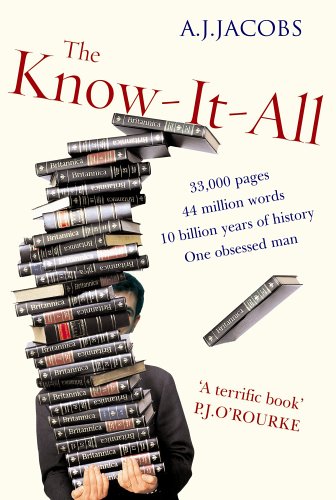
The Know-It-All by A.J. Jacobs

28 08 2017

So a bloke decides he wants to become more intelligent, and so gets all 33,000 pages of the 2002 edition of the Encyclopaedia Britannica and sets out to read them in the space of the year.

Seemed like quite a Gormanesque style of challenge, which I always enjoy, so when my friend picked up on my enjoyment of the idea, she got it for my birthday – perfect!

The book is structured so that you’re always under the subheading of one of the articles he’s decided to tell you about, but often he’ll go off on a tangent, and sometimes a full blown life anecdote.

We learn that he and his wife are struggling to conceive and follow that part of his life, alongside all his attempts to show off his new found knowledge. This includes applying to MENSA, auditioning for Who Wants To Be A Millionaire, trying an evening on a college debate teamand even pointing out an error in one of the articles!

He also lists things he thinks you can do to make you more likely to get into the “EB” as he affectionately calls it, things like getting beheaded, being a botanist, etc. He also keeps lists on his computer of ironic facts he discovers, people who married their cousins, all sorts of things.

He spends several hours each morning and evening reading, and so tries out a speed reading course to see if that will help, and later on does admit to skim-reading some of the heftier stuff, though he does pledge to read every word of Q! He also gets to go on a tour of the Britannica office and have a go at editing an article (given his full time job is an editor at a magazine, this is less shocking than it initially sounds!).

It was like reading a short, chatty version of the encyclopaedia – I learnt a few things, not many that will stick (a problem he also found as he went through it!), but interesting at the time. There wasn’t much of a dramatic climax or anything, I thought he might struggle to keep pace, but that didn’t seem to be an issue, but it was fun to just learn and get to know him at the same time. Definitely will try some of his other books!
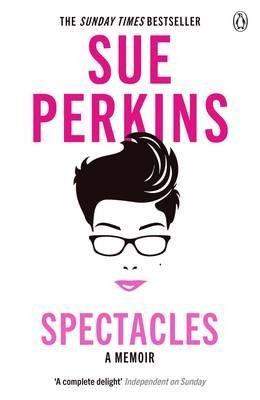
Spectacles – by Sue Perkins

1 08 2017

I honestly feel like I’ve just spent a week hanging out with this woman! I had high expectations from the book and she didn’t disappoint.

She writes just like she talks, lots of random ad-libs, clever jokes, all sorts. Very clever and very quick!

She describes things so beautifully, and none more-so than her first meeting with Mel Giedroyc, just stunning! She also talks about her family with such affection, amid all their nuances there’s proper love there 🙂

It’s hard to say much about this book because she says everything so much better. All I can say is I read a 400 page book in 8 days – that NEVER happens!


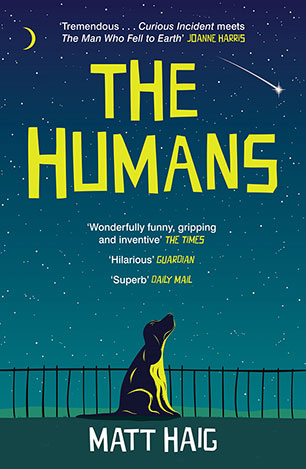
The Humans – by Matt Haig

23 07 2017

Last year I read Reasons to stay alive, and can confidently say it’s one of the best things I’ve ever read. That book was non-fiction, but Matt Haig has mostly written fiction, which is also raved about and so I asked for The Humans for my birthday this year.

I’ve tried to explain the premise to a few people, and haven’t done very well so here goes nothing: One day, Andrew Martin manages to prove the Riemann Hypothesis and some aliens on another planet, believing that this is a threat to the cosmos, send one of their kind down to earth to destroy this man and anyone else he might have told. Cheery so far, right? So this alien goes down, Andrew is destroyed and the alien takes on the form of Andrew Martin, and seeks to determine what his wife and son know, and who else Andrew might have told, with the intent of destroying all who are aware so that this never gets out.

But in a way, that’s not the point of the book. This is a creature experiencing humans for the first time. He’s learnt about them in theory, but in practice there seems to be a lot more to them, and he’s keen to spend a bit longer working this out before completing his mission. It’s a reflection on us as creatures, which in some places makes you think, and in others is downright hilarious!

As is often the case with this sort of book, I ended up folding down a lot of page corners, and so some of my favourite quotes are below:

  • “It was comforting to know that even in the most remote corner of the universe the laws of sound and light obeyed themselves, although it has to be said they seemed a little more lacklustre here.”
  • “They placed me inside a small room that was, in perfect accord with all human rooms, a shrine to the rectangle.”
  • “Indeed, it is mathematics itself which is the bedrock of civilisation.”
  • “If God exists then what is He but a mathematician?”
  • “A prime number is strong. It does not depend on others.”
  • “I don’t have a name. Names are a symptom of a species which values the individual self above the collective good.”
  • “It was then that I realised the one thing worse than having a dog hate you is having a dog love you.”
  • “Listening to music, I realised, was simply the pleasure of counting without realising you were counting.”
  • “I was still ‘recovering’, you see. Recover. The most human of words, the implication being that healthy normal life is covering something.”
  • “Our beautiful, warless world, where I could be entranced by the purest mathematics for all eternity.”
  • “Overall, the sensation I was feeling was one of conscious decay. In short, I felt human.”
  • “Mornings were hard on Earth. You woke up tireder than when you went to sleep.”
  • “She knew one day her husband would die and yet she still dared to love him. That was an amazing thing.”
  • “Crossing [the road] at an angle that tried to balance the concealment of fear with rapid avoidance – that angle being, as it was everywhere in the universe, 48 degrees away from the straight line on which we had been travelling.”
  • “Whatever it is, you’re becoming a man of honour. And that’s rare for mathematicians.”
  • “The ‘pub’ was an invention of humans living in England, designed as a compensation for the fact that they were humans living in England. I rather liked the place.”
  • I wanted to put the whole preface down but realised that might be bordering on copyright infringement so I’ll let you find that for yourselves in a shop or library!

    There is also a chapter called “Advice for a human”, but given that that contains 97 points I’ll again leave that for you to discover yourself!

    (If it wasn’t clear from the above – I thought this book was brilliant and already have a list of people I want to lend it to!)


Eligible – by Curtis Sittenfeld

12 07 2017

If you saw this on the shelf in a bookshop/library/supermarket/etc you’d be forgiven for having no idea that it’s part of The Austen Project!

This is the first time one of the authors has changed the title of their book. I’m not entirely sure why they did it, but who am I to judge? I think I’ve enjoyed this one the most so far. Some of the previous books have just modernised by throwing in facebook and mobile phone references, but this one had a full blown revamp.

Liz is 38 and a writer for a magazine, Jane is 39 and a yoga instructor, and they live in New York, but have had to go back to the family home as Mr Bennet has a heart attack. Lydia, Kitty and Mary are in their 20s and still living at home and pretty much just living off of the family money. Chip Bingley and Fitzwilliam Darcy are Doctors/Surgeons, and Chip has recently become famous on a reality TV show called “Eligibe” which is essentially The Bachelor. The Collins subject is dealt with by changing him from a cousin (which was fine to marry in those days!) to a step-cousin (technically fine, but still a bit weird), which seemed like a really sensible change to make.

They don’t stick religiously to the plot either. I won’t ruin this with spoilers but there are two separate characters that take a story line each of Willoughby’s character from the original, there’s IVF, a LGBTQ subplot, and as already mentioned, reality TV – definitely a long way from Austenland, and yet, while you’re reading it, you don’t feel far off at all.

Mr Bennet is still the same wonderful man, and definitely one of my favourite characters with some of the best one liners.

“My dear,” said Mr Bennet, “if a sock puppet with a trust fund and a Harvard medical degree moved here, you’d think he was meant to marry one of our girls.”

“Plenty of men don’t want children.” Mr Bennet took a sip of coffee. “I’m still not sure that I do.”


Deep and Wide – by Andy Stanley

28 06 2017

A six week read isn’t a great start to my 30 books in a year, but I’ve always been a bit slow with non-fiction! For the first time in many many years, this was a book that I was actually asked to read. I think the last time that happened was school, and that also made me a slow reader!

The book was set for a course our church leadership team is on; the book’s subtitle is “creating churches unchurched people love to attend” which is the book in a nutshell. It’s a great re-focus and reminder, and the book had a load of things to think about and consider. I ended up using a pencil as a bookmark so that I could underline lots of bits and pieces.

That said, the guy is a megachurch pastor. My church is not a megachurch. Sometimes that means things he suggests just aren’t practical (three teams of people to put a sermon together?!), and sometimes he uses terminology that just made me cringe (audience instead of congregation), but there are definite things I got out of this book, some more practical, some more theological, but for a non fiction book, I really did enjoy most of it!


Girl with a Pearl Earring – by Tracy Chevalier

12 05 2017

Another recommendation from my Mum, she claimed she read this in a day, and it wasn’t too thick either, so despite knowing zilch about art, I decided I’d give it a go.

The book is about a maid, Griet, who is 16 and works in the house of a painter called Vermeer. Vermeer is a real life artist, you can look him up on Wikipedia and everything! But it’s probably important to say at this stage that the book is a historical fiction. There are elements about it that are true, his patron in the book also existed in real life, but the main storyline was created by the author.

The book isn’t just about the famous painting, that comes later; Vermeer paints a few paintings while Griet works for the family, but what’s great is that if you look up his paintings, you can see that Chevalier was referring to real paintings of his each time as she went through the detail of the compositions.

Throughout the book Griet is wooed by the local butcher boy, but she also has feelings she doesn’t understand for Vermeer as she cleans his studio, and then as time moves on, is allowed to assist him in mixing his paints from their raw ingredients (because, of course, this is 350 years ago, you didn’t just buy paint!).

The story is set in Delft in the Netherlands, which I actually visited when I was 12. I love Holland, I have relatives there and it’s where my name comes from, so when I realised the book was set there, I was excited to read more!

I’d definitely recommend this for a fairly easy read. I like real life stories, and while this isn’t one, the few bits of reality in it make it feel like it is!

Looking forward to renting the film to see what they did with that!