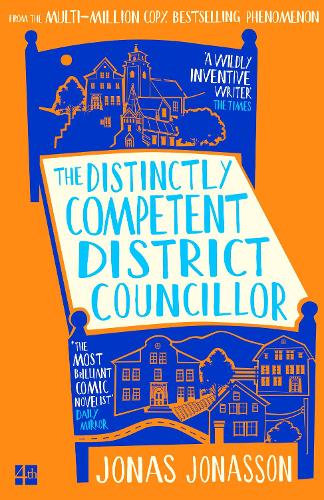
The Distinctly Competent District Councillor – by Jonas Jonasson

16 06 2026

As a big fan of Jonas Jonasson, I was excited to get his latest book for my birthday – what I didn’t realise was how much shorter it is than his other books so far at only ~130 pages!

He explains in the opening note to readers, why he wrote this book at this time:

“The times we live in are anything but simple, with war and conflicts everywhere, and it was for this reason that I felt the urge to write something that might give us hope. I wanted to write about friendship between people from different nations. Between my Swedish compatriots, for example, and the Germans, of whom I have grown very fond in recent years. And what came out was this story about a small town in Sweden where things are difficult: unemployment, young people moving away – even the local bookshoop has had to close. It doesn’t get much worse than that! But when blue and yellow meets black, red and gold, things finally start looking up…
With this in mind, I hope you enjoy my small contribution to German-Swedish friendship. Happy reading!”

So, from the blurb:

“All over the world, people sleep blissfully in Traumbett beds. These marvellous feats of German engineering have successfully cornered the mattress market everywhere. Everywhere, except Sweden and owner Konrad Kaltenbacher Jr is desperate to expand there.
With Konrad Jr’s sights set firmly on stylish Stockholm, Julia Bäck, district councillor of the small, decaying town of Halstaholm, has plans of her own. Seeing an opportunity to attract 800 new jobs, Julia jumps into spearheading a persuasive campaign to win the contract. A roundabout is hastily renamed in honour of Angela Merkel; a German school is quickly established under the leadership of a ten-year-old boy and three elderly pensioners; and the town swimming poo is rapidly transformed into a beerhouse – it had been empty for years anyway!
Julia’s get-up-and-go impresses the German boss… but has she made herself a tricky bed to lie in?”

It didn’t feel quite as wild and wacky as his other books, probably mostly due to the length, but if you hadn’t read his other stuff, you’d definitely still think it was a bit out there!

There were a few confusing moments when the book had to specify something was said in English, since they’re translated from Swedish, clearly in the original it would have been obvious, but for us, far less so!

A couple of standout lines:

  • ‘”Have you thought this through, dear?” she added.
    “No,” said the mayor. “When would I have had time for that?”‘
  • ‘There’s plenty wrong with me, I will admit. Just ask the fish in my aquarium at home, he knows. Or maybe he’s a she? I have no idea. It might be better not to know; he or she doesn’t talk, anyway. Autistic, is my guess.”‘
  • And just a wonderful moment when someone is requested to get a statue of Franz Beckenbauer, a famous German footballer, but none are available, so they’re just told to get another German: “It doesn’t matter who, as long as he’s famous”, so you can guess what direction that goes in….


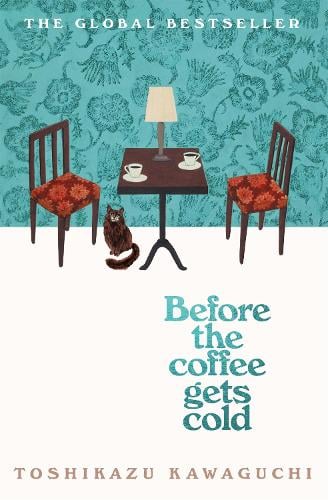
Before the coffee gets cold – by Toshikazu Kawaguchi

8 06 2026

I feel like this book was everywhere about 5 years ago, and now I’ve finally got around to reading it after needing something to top up a Waterstones order to get free delivery!

From the blurb:
“In a small back alley in Tokyo, there is a cafe which has been serving carefully brewed coffee for more than one hundred years. But this coffee shop offers its customers a unique experience: the chance to travel back in time.
In
Before the coffee gets cold, we meet four visitors, each of whom is hoping to make use of the cafe’s time-travelling offer, in order to confront the man who left them, receive a letter from their husband whose memory has begun to fade, see their sister one last time, and meet the daughter they never got the chance to know.
But the journey into the past does not come without risks: customers must sit in a particular sear, they cannot leave the cafe, and finally, they must return to the present before the coffee gets cold…”

One of my favourite things about this book I discovered before I even started – in the front of the book is a relationship map of characters! This was so useful, showing who everyone was, and how they linked together. Particularly useful in this case as the names being Japanese were less familiar to me, and a lot began with K, so it was easy to confuse them while settling into the story. More books need this!

So the rules of the cafe are thus:
1. The only people one may meet while back in the past are those who have visited the cafe
2. No matter how hard one tries while back in the past, one cannot change the present
3. In order to return to the past, you have to sit in that seat and that seat alone
4. While back in the past, you must stay in the seat and never move from it
5. There is a time limit, you must return before the coffee gets cold
6. A person who has sat on the chair to travel through time once cannot do it a second time. Each person receives only a single chance

The book is divided into four chapters, one for each scenario, but the characters are all interwoven throughout so where I wondered if it might read as a set of short stories, it didn’t, there was flow throughout with all the characters knowing each other and being in the cafe for various reasons, and each had a flashback or two to share some backstory.

I’m not sure I’d read the rest of the series, I guess it depends how they work, whether it’s another set of characters and their stories, further travels with these characters, or something else entirely. But it was a really nice idea and I enjoyed it.


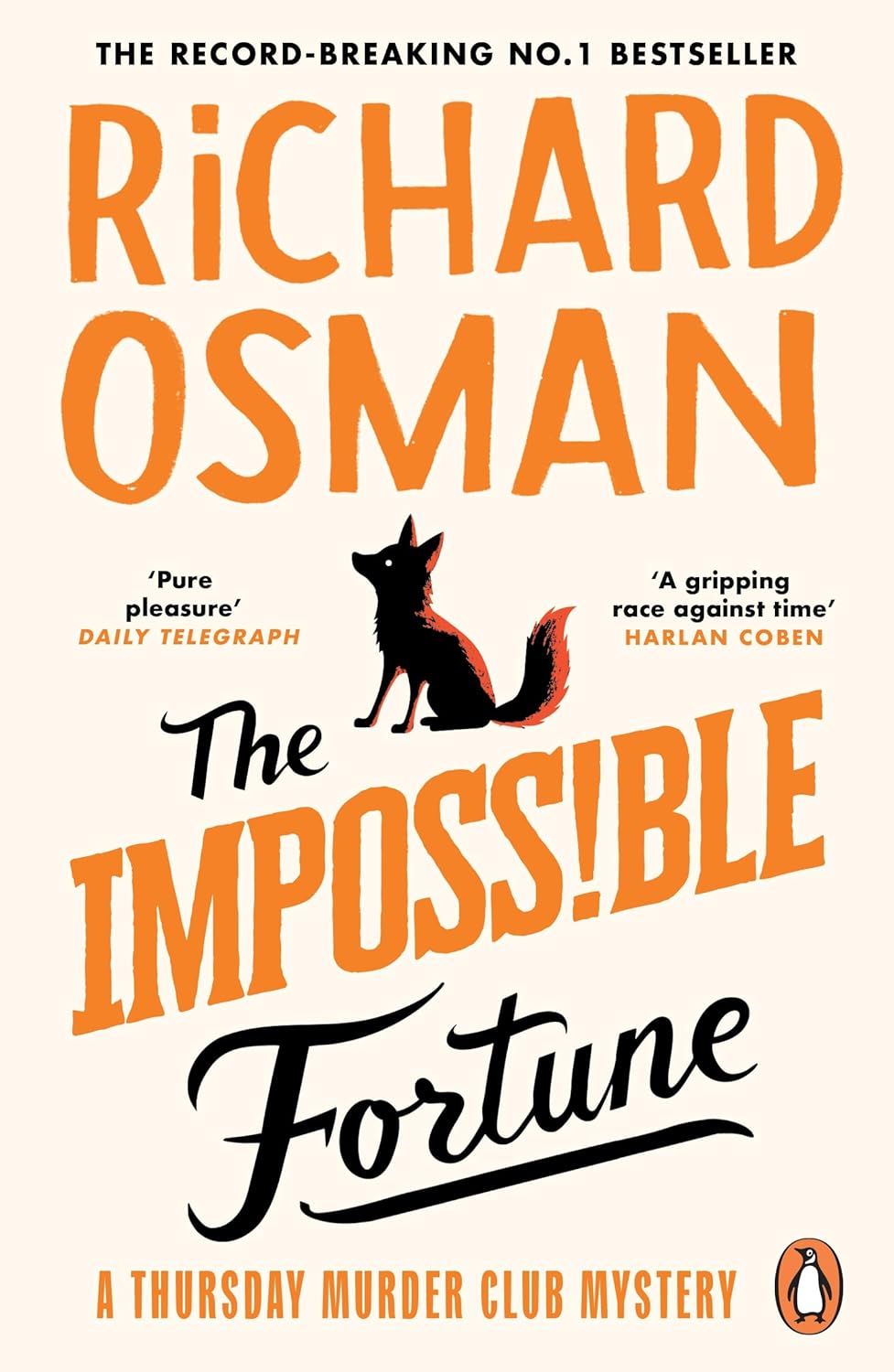
The Impossible Fortune – by Richard Osman

19 05 2026

So we reach the fifth book in the Thursday Murder Club series, and I think it’s been my favourite so far! There’d been a two year gap since the fourth book was released, and so after such a long time away, just within a couple of pages of starting I felt all warm and fuzzy, realising how I’d missed the characters, particularly Joyce!

The book start’s with Joyce’s daughter Joanna’s wedding, but within 24 hours we have a missing person, a dead person, and $350m worth of bitcoin at stake if only they can work out how to get hold of 2 parts of a code.

This sounds very dramatic, but of course, it’s Thursday Murder Club, so as well as plenty of excitement, there’s also plenty of mundane and lovely moments, and of course some excellent little lines.

  • “If we have different ideas about gluten, we’re going to have different ideas about most things.”
  • “That’s the problem with going out. One thing leads to another, and you find yourself going out again.”
  • “She remembers when Dan Hatfield had two arms. The money he’d wasted on tattoos on that other arm.”
  • “Rightmove teaches you an awful lot about the world, and also a lot about people’s taste in curtains.”
  • “That must be the world’s shorted honeymoon […] I feel like Liz Truss.”
  • “Amazon deliveries have been the single greatest boon for professional hitmen. Everyone is always expecting one.”

I’m just sad it’s another two year wait ’til the next one now, they’re such a fun gang to hang out with!


Flatland – by Edwin Abbott Abbott

9 05 2026

This is a weird book. It’s a novella, set in a two dimensional world, narrated by a square. In the first half of the book he explains how their world works, in the second he talks to both the king of Lineland (a one dimensional world) and a sphere from Space (the three dimensional world). Obscure enough for you yet? Well take all that, and then skew your head around it being written in 1884, Victorian times. Bizarre!

So in Flatland all people are shapes, which is how class is decided. The lowest class are triangles, and the more isosceles, the lower they are, all the way through to polygons with so many sides they appear to be circles, these are the highest class of people. All shapes beyond triangles must be regular, or else will likely be banished from society. But we must remember that this was written a very long time ago, and so the exception to the above is women; all women are single lines, which tells you a lot about how they’re talked about in this book eg “they are consequently wholly devoid of brain power”, though at times they are also referred to as “formidable”, and “by no means to be trifled with” thanks to the sharp end of their line, sharper than any man’s angles.

Now, since it’s two dimensional, all you can see is one dimension (in the same way that in our three dimensional world, we see two dimensions), and so all these different shapes, at first glance look like just lines. They identify each other either by feeling, or with a bit of depth perception since there is normally a slight fog or mist. This is all explained in the book in a LOT more detail! You may wonder why they can’t be identified by some colour change or design, well, they used to, but there were problems with people faking their colours, and so now all colours are banned.

You may be spotting many holes in how life might work in a two dimensional world, and handily, these are skipped right over as our narrator, the square, decides it’s high time he moves on to the next section of the book, and so says he won’t have time to cover “our method of propelling and stopping ourselves, although destitute of feet; the means by which we give fixity to structures of wood, stone or brick, although of course we have no hands, nor can we lay foundations as you can, nor avail ourselves of the lateral pressure of the earth; the manner in which the rain originates in the intervals between our various zones, so that the northern regions do not intercept the moisture from falling on the southern; the nature of our hills and mines, our trees and vegetables, our seasons and harvest; our Alphabet and method of writing, adapted to our linear tablets; these and a hundred other details of our physical existence I must pass over.”

So that’s the first half dealt with! In the second, he first meets the Monarch of Lineland, and tries to explain to him life in two dimensions, which he obviously cannot understand, any more than we could understand what a world with four dimensions might look like. In Lineland, they can’t pass each other to get anywhere, but he explains that they can communicate over thousands of miles by sound, even to the point of impregnating, which requires one man and two women, and will always produce three children in that same ratio to preserve how that society works.

Following this, a sphere intersects the plane of Flatland and tries to explain life in two dimensions to the square. The irony of the conversation being the same with the same frustrations at not being understood now the show is on the other foot, is quite funny, but eventually the sphere is able to bring square out of Flatland into Space, and show him!

Then comes his return to Flatland, and his attempts to convert folk to the Gospel of the Three Dimensions, but this is an imprisonable offence….

What did I tell you – weird! Just feels way too abstract for something of that era, though I guess it’s not far off Lewis Carroll, and he wrote some weird stuff too….


Charlotte’s Web – by E.B. White

25 04 2026

I never read this as a kid, and found it at a book fair in a 3 for £1 deal, so thought I’d give it a go! Other than know it was about a girl, a pig and a spider, I had zero idea of the plot!

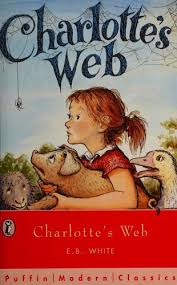
The opening is brutal, given it’s a children’s book – “Where’s Papa going with that axe?” it turns out, he’s off to kill the runt of a litter of pigs born last night. What a start! Well Fern (the girl on the front cover) begs him not to, and raises the pig, Wilbur, on a bottle. Other than this bit at the start, I’d argue Fern is made a bit too much of, the bulk of the story is about Wilbur, Charlotte the spider, and the other animals in the barn, while Fern just starts to take an interest in boys. I’m not sure she deserves to be on the front cover!

One thing I struggled with (and I’m aware this sounds stupid) is that while I was very happy to suspend my disbelief insofar as animals talking is fine, but when, a few times in the book, Wilbur did a backflip, occasionally with a half twist, that seemed a bit ridiculous to me. Yes, I heard myself, ridiculous double standards!

Towards the end of the book there is a very sad moment, *spoiler alert* where Charlotte sadly passes away. There’s a line that’s a proper punch in the stomach as the chapter closes – “No one was with her when she died.” But it’s a children’s book, so it still finishes on a positive and we all end happily.


All the Light We Cannot See – by Anthony Doerr

16 04 2026

I was leant this book by a friend who loved it. I’d heard the title around for a long time and always meant to get around to reading it somewhen.

Marie-Laure is a French girl who became blind as a child, her father is the locksmith for a massive museum in Paris. When the Naxis invade, they flee to his Uncle’s in Saint Malo, keeping safe something from the museum.
Werner is a German orphan, brought up in a mining area with his sister, but he teaches himself to repair radios and transmitters, and ends up in a school for elite military training.

The book alternates between their two stories throughout, as well as jumping from before the war to late in the war and back again. I don’t mind a parallel storyline, and I enjoy a dual perspective, but following both was occasionally a bit much, especially when an occasional third perspective came in!

It’s extremely readable and engaging, you really get a feel for the horrors of the time, especially the stuff in August 1944 during the siege of Saint Malo. There were a handful of Americanisms in the text, which sort of pulled you out of the story for a second, but it wasn’t too often. The only other thing that bothered me was the tiny romance storyline, which to me felt a little shoehorned in, but overall I really enjoyed it.

Next stop will be watching the Netflix adaptation.


The Christmas Tree that Loved to Dance – by Miranda Hart

28 12 2025

And beautifully illustrated by Lucy Claire Dunbar, this short story (or “tall tale”) is a very sweet little story about Joan and her dog Jessie, who see men stealing discarded Christmas trees in January from the side of the road, and want to rescue them!

If you’re not familiar with Miranda, some of the phrasing might seem slightly peculiar, but if you are, it’s just some of her intonations and ways of speaking that are so clear in how she writes!

Slightly wacky in places, but I suppose that’s what you expect from a Tall Tale!


Into the Storm – by Cecelia Ahern

2 11 2025

My annual Cecelia Ahern read! I’ve found she tends to write two kinds of books, all fiction, but either with or without an element of magical realism, so whenever I start a new one, it’s interesting to see which it will be! In this case, it’s just general fiction, but a story I really got invested in.

Enya is a GP, and driving home from a call out during awful weather on the shortest day of the year she comes across the scene of an accident, a teenager in the road, and a man who says he just drove up and found him there. She obviously stops to help, but where she’d been struggling mentally with approaching the age her mother died, and following this trauma, she decides it’s time for a big change.

The story continues both with her adapting to her new life, while also dealing with the fall out from that night, and gradually finding out more about what happened, so that by the end of the book, we have the full story.

The book is broken into different times of the astronomical year, her mother had an interest in pagan ideas, and there’s a rag tree involved in the story – I was a bit concerned at one point about how pagan-y it might get, but it really wasn’t much at all in the end.

I enjoyed seeing how Enya’s relationships with her son, her sister, and others she meets along the way change and develop through the book, and particularly with the woman who lives above her surgery who is going through her own struggles.


Jane Eyre – by Charlotte Brontë

19 10 2025

For my annual read of a classic, I went for Jane Eyre. The last six years I’ve read the main six Austens, so thought it was time for my first Brontë (Charlotte). I’d watched the Ruth Wilson adaptation before, and had a rewatch for a refresher before I got going.

In my head, I didn’t think it wouldn’t be that much different to an Austen, the books are within a few decades of each other, but it’s definitely darker and grittier, and less about society. Another massive difference is that it’s told in the first person, from Jane’s perspective, and so is much more emotive and engaging in its narrative.

The book follows Jane’s story from orphaned child living with family that don’t want her, through boarding school, to working as a governess in a house with a secret, and the fall out from that.

I was grateful that my edition had notes in the back, they were helpful to explain a few terms we no longer use, as well as when the girl she was governess for chattered away in French, it kindly gave a translation! One thing I found utterly bizarre though, is that any large place name was anonymised! So you’d get references to -shire, etc. I googled and this seems to be a thing from the time, as if the fact it’s been anonymised makes it sound like they’re real people, but it took some getting used to. Also, the number of times that a door or a box or anything was “unclosed” instead of opened – I wonder when that changed! I really enjoyed when at one point she said “thither I bent my steps” – so similar to the line in ‘O Come All Ye Faithful’ which has always tickled me!

There is talk throughout the book of how Jane is not attractive, both from her and others saying it about her, and the same is said of Mr Rochester, they say it to each other, it’s really quite refreshing, and made the characters feel a lot more relateable. I also love when her refers to her as Janet, I never thought of it as a pet name for Jane, but maybe it is?!

As per usual, a few bits that made me turn down page corners:

  • “Children can feel, but they cannot analyse their feelings; and if the analysis is partially effected in thought, they know not how to express the result of the process in words.”
  • “It is not violence that best overcomes hate – nor vengeance that most certainly heals injury.”
  • “We know that God is everywhere; but certainly we feel His presence most when His works are on the grandest scale spread before us; and it is in the unclouded night-sky, where His worlds wheel their silent course, that we read clearest His infinitude, His omnipotence, His omnipresence.”
  • “I would always rather be happy than dignified.”
  • “As she grew up, a sound English education corrected in a great measure her French defects.”

In summary: Reader, I loved it.


A Beginner’s Guide to Breaking and Entering – by Andrew Hunter Murray

23 08 2025

Very different from his first novel (and I haven’t read his second!) – the premise of this book sounded so much fun: a guy who house sits for rich people, except they don’t know it. You might call him a squatter, he calls himself an interloper. He stays in wealthy people’s second homes when he knows they’re away, and leaves no trace – fun, yes?!

I thought the whole book was going to be based around this, and in a way it is, but really it’s more that that’s the set up for the story, which is sort of a murder mystery while on the run as suspects. I don’t think that gives too much away as it’s on the back of the book! It’s even narrated from the information suite in his prison…

I really enjoyed it, there’s a good amount of fun among the drama, and a few niche British references that would make Richard Osman proud! (eg: “I wonder fleetingly whether the police and the Bake Off crew get their marquees from the same firm.”).

There was also a wonderful anecdote about Ann Hicks, who sold apples in Hyde Park in the 1830s, built a tiny shack to sell from, gradually added to it, windows, doors, extended upwards, until she had a two storey house and a shop front in the middle of Hyde Park. Due to patchy records, she ended up being paid a weekly allowance by the Duke of Wellington to leave so they could build a bit crystal palace – a brilliant story, and clearly Hunter Murray’s QI-elf-ness hasn’t completely left him!

I think what I’d really like is a prequel, maybe a series of short stories of his escapades before this whole incident kicked off, of life as an interloper. It’s fun in this book to learn of his series of rules of interloping, but there must be stories from where some of them came from that could be a good premise.

A couple of excellent lines:

  • “I have a faint memory that impersonating a police officer is a crime that comes with an especially long sentence. The police don’t like it when you do impressions of them. (I find this particularly unfair, because apparently they’re allowed to do impressions of normal people and that’s just ‘undercover work’.)”
  • “You may have noticed that I’ve also changed Qumar’s name, from a country you will be familiar with to a fake country they use in The West Wing when they needed somewhere for President Bartlet to bomb. If Aaron Sorkin objects to me lifting the name, he can sue me. I’m literally writing this from prison and have no fear of copyright infringement.”
  • “I do look up the price of ferry tickets, then a few property portals to see how much the average mountain chalet sets you back these days (a lot, it turns out; these ski people must be made of money and still they choose to go somewhere cold? Insane)”