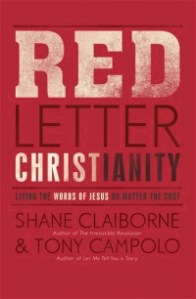
Red Letter Christianity – by Shane Claiborne & Tony Campolo

22 06 2014

My colleague Wendy recently said, “Most people who go to a Tony Campolo event know that they’re going to get ‘beaten up’ for justice.” and this book wasn’t far off of a punch in the face either – in a good way of course! I’ve heard both of these guys speak before, and always find they challenge my way of thinking and being. The book was no different.

The idea of Red Letter Christians is that they live their words specifically by the words that Jesus said. In some copies of the bible, every word Jesus spoke is printed in red so as to stand out from the black text.

Each chapter of the book took a different topic that Campolo and Claiborne would then discuss between them, sharing thoughts and perspectives. I found some of what they shared truly refreshing; they didn’t just go down the line you might expect them to!

In the chapter on pro-life, I expected this to just be a discussion on abortion, and of course some of it was. But there was also a lot of discussion on the quality of life throughout the whole of a persons life: “from womb to tomb”. They covered poverty, sin, and the death penalty alongside the obvious.

In the chapter on homosexuality, they open by discussing gay marriage, but actually when Tony shared his view on it, it took a whole new direction:

“While I believe that the government should not legalise marriage for people who are gay, I also believe that it should not legalise marriage for heterosexuals either. In fact, the government should get out of the marriage business completely and instead focus on civil rights for all of its citizens. It should treat both homosexual couples and heterosexual couples the same, guaranteeing both the same rights and privileges. Homosexual couples and heterosexual couples should be able to go down to the city hall and register as couples who want to be legally recognised as belonging to each other and receive the same civil rights available for all citizens who want to be in committed relationships. Then, if a couple wants to call the relationship a marriage, that couple should go down to a church and let the church perform the ceremony.” – Tony Campolo

The chapter on giving I found particularly helpful, confirming some stuff I’d been thinking about recently anyway, and looking at some prosperity gospel stuff which seems to keep rearing its head lately too.

Every chapter of this book had something to make you think, from liturgy to the middle east, from reconciliation to national debt, there isn’t a lot they don’t touch on somewhere and just stir some of your thought patterns that maybe had sat still for a bit too long.

Red Letter Christianity


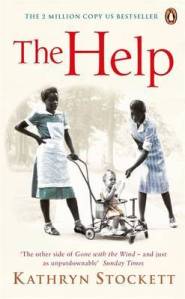
The Help – by Kathryn Stockett

15 03 2014

I’d seen the film, but it was quite a while ago and I didn’t really remember it, so in many ways, this was like reading a new book.

The story is set in 1960s Mississippi, and looks primarily into the lives of a few white women, their maids and their children. Now I wasn’t anywhere near alive in the ’60s, but I thought I knew a bit about what had gone on. I know about Rosa Parks, I know about Martin Luther King, and I know about Apartheid in South Africa. I did not know that a white woman would consider, let alone actually build a separate toilet outside her house for her maid to use so that she wouldn’t catch diseases from her. I didn’t know that to serve a white woman her coffee you would set it on the table rather than give it to her for her fear that her hands may touch yours and catch something. I am privileged to have grown up in an environment where this would never be tolerated, though I know that in some places things still aren’t quite right.

It was really encouraging to find out at the end that while it this wasn’t based on the authors life per say, she did grow up with a black maid who she was close to around this time, and so in general it was based on life at that time, though the book itself is fiction. It does close with a nice little account of her story in the back though.

The book itself has three women sharing the job of narration, two black maids and one white woman who isn’t quite like the rest of them. Just home from college and living back with her mother while her friends are married and enjoying high society life, she is far more interested in what life is like for the maids.

Definitely a bit of an emotional rollercoaster – there’s time for laughter, sadness and anger definitely, but it really opened my eyes to what things used to be like compared to what they are now, but also was genuinely a great read. One of those books you carry around with you incase you find a chance to read a few more pages!

the help