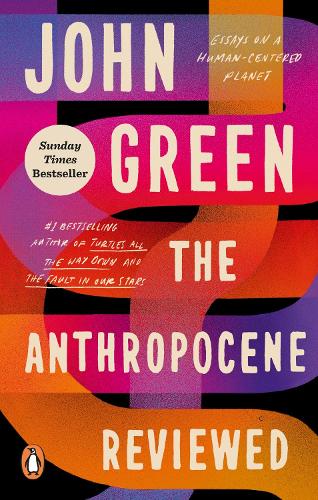
The Anthropocene Reviewed – by John Green

21 02 2026

Several years ago I worked my way through John Green’s fiction writings, then more recently I was recommended his podcast and youtube channel, both run with his brother, also author, Hank Green. I’ve enjoyed their chatter, and when I heard about this book I thought it’d be an interesting read, very different from his other stuff.

Let’s start with a definition, the Anthropocene is a proposed term for the current era of Earth’s history. This book comes out of a podcast of the same title, and is a set of essays which are all fundamentally reviews of different things, as Green used to write book reviews for a living before he became an author.

Some chapters were more serious than others, I think I’d assumed the whole book would be a bit more tongue in cheek, which is maybe why I didn’t give it as high a rating as I expected to. I learnt about some really interesting things, such as the Lascaux cave paintings, and the Champion’s League final 2005. There were also chapters on Diet Dr Pepper, Scratch’n’Sniff stickers, and the world’s largest ball of paint.

My paperback edition had a couple of extra bonus essays at the back, one of which felt very much like it was repeating an earlier story he shared, but who knows if it was just something I’d recently heard elsewhere as it wasn’t personal to him!

Of course, there were quotes to repeat:

  • “Never predict the end of the world. You’re almost certain to be wrong, and if you’re right, no one will be around to congratulate you.”
  • “Humans are already an ecological catastrophe […] for many forms of life, humanity is the apocalypse.”
  • “It’s no coincidence that the scientific revolution in Britain coincided with the rise of British participation in the Atlantic slave trade and the growing wealth being extracted from colonies and enslaved labour.”
  • [Discussing how we can’t look directly at the sun] “In the Book of Exodus, God says, ‘You cannot see my face, for no one may see me and live.’ No wonder that Christian writers have for centuries been punning on Jesus as being both Son and Sun.”
  • “Colour is a fiction of light.” – Tacita Dean
  • “What’s news isn’t primarily what is noteworthy or important, but what is new.”
  • “It’s been my experience that almost everything easy to mock turns out to be interesting if you pay closer attention.”
  • “Cholera continues to spread and kill not because we lack the tools to understand or treat the disease as we did two hundred years ago, but because each day, as a human community, we decide not to prioritize the health of people living in poverty. Like tuberculosis, malaria, and many other infectious diseases, cholera is only successful in the twenty-first century because the rich world doesn’t feel threatened by it. As Tina Rosenberg has written, “Probably the worst thing that ever happened to malaria in poor nations was its eradication in rich ones.”
  • “Even the most extraordinary genius can accomplish very little alone.”
  • “Almost everything turns out to be interesting if you pay the right kind of attention to it.”


The Good Immigrant – edited by Nikesh Shukla

9 08 2020

Never in my life did I think I’d choose to read an essay collection; but when the focus/intention is something so important, the tone is relatively auto-biographical, and the reviews are so strong, it seemed worth giving it a go.

I think what surprised me most about this book (though of course it shouldn’t have) was the variety. As “21 writers explore what it means to be black, Asian & minority ethnic in Britain today”, not once did I think it was getting repetitive. The contributors are from all sorts of backgrounds, cultures, ethnicities [which, interestingly, spell-check doesn’t recognise as a word?!]. Some are UK born, some immigrated, and they talk about different things, some more on a specific topic, some more just telling their story. It gives a great insight into a world that those of us with white privilege just haven’t experienced.

At the start of the book there is a mini-bio for each author (and their twitter handle), but then it just dives right in, the first essay being from Shukla, and going on from there.

To give a flavour of what sort of things the book covers, I’ve put some example paragraphs and sentences below:

  • “A comedian, Kumail Nanjiani, an avid gamer, once expressed his delight that the Call of Duty series finally set a level in Karachi,[…] He was appalled, on playing the game, to see that the street signs were in Arabic. Not Urdu. He talks about the effort put into making each follicle on each soldier’s head stand out, into making their boot laces bounce as they ran, the millions spent developing this game, and how at no point did anyone decide to Google the language of Pakistan.” – Nikesh Shukla
  • “There was one thing I’d never considered about mixing red and yellow: a drop of yellow into red paint won’t do much to change the colour, but one drop of red into yellow and the whole pot is tainted forever.” – Varaidzo
  • “When we talk about race, the words ‘black’ and ‘white’ are familiar. ‘Brown’ too has come into play. I use the word ‘yellow’, offensive as many find it, because this is how I believe I’m seen.” – Vera Chok
  • “There was a point in the past when I stopped dressing ‘prettily’ because when I was out with ANY white man, no matter his age or looks, I was talke over and looked down on. It was assumed that I was his escort or mail-order bride.” – Vera Chok
  • “It transpires that my family were the unwitting pioneers of multiculturalism in St Neots – as far as Dad can recall, they were the only South Asian family in their immediate area, perhaps even the whole town. I assumed that Dad and his family must have felt ostracised. I was wrong: Dad can’t recall ever feeling that way. Whereas the segregated immigrant communities in the big cities were bearing the brunt of xenophobia, no one in St Neots seemed to have any problem with my family joining their community.” – Himesh Patel
  • “The only thing worse than racism is inaccurate racism.” – Nish Kumar
  • [Referring to teaching a class of year 2 children about writing stories] “When it came to sharing their stories, I noticed only one boy had acted upon my suggestion, naming his main character after his uncle. He had recently arrived from Nigeria and was eager to read his story to the class. However, when he read out the protagonist’s name, another boy, who was born in Britain and identified as Congolese, interrupted him. ‘You cant say that!’ he said. ‘Stories have to be about white people.'” – Darren Chetty
  • “It is interesting that the classifying seems to be done y those with lighter pigmentation.” – Sabrina Mahfouz
  • “What the comment made by the young women highlights again is this problematic assumption of an individual’s heritage based purely on an aesthetic they appear to fulfil.” – Sabrina Mahfouz
  • “Portrayals of ethnic minorities worked in stages, I realised, so I’d have to strap in for a long ride.
    1. Stage One is the two-dimensional stereotype – the minicab driver/terrorist/cornershop owner. It tightens the Necklace.
    2. Stage Two is the subversive portrayal, taking place on ‘ethnic’ terrain but aiming to challenge stereotypes. It loosens the Necklace.
    3. Stage Three is the Promised Land, where you play a character whose story is not intrinsically linked to his race. In the Promised Land I’m not a terror suspect, nor a victim of forced marriage. In the Promised Land, my name might even be Dave. In the Promised Land, there is no Necklace.”

    – Riz Ahmed

  • “My ‘random selection’ flying to LA was so reliable that as I started travelling more, I went through a six-month stretch of being search by the same middle-aged Sikh guy. […] I’ve had my films quoted back at me by someone rifling through my underpants, and been asked for selfies by someone swabbing me for explosives.” – Riz Ahmed
  • “The racism practised by white British people extends to all, not just those of a lower caste. Racial discrimination does not distinguish between Dalits and Brahmins; to racists, all Indians are the same.” – Sarah Sahim
  • “From India to Africa, the Caribbean, all over the world, skin bleaching is big business and the shade of your skin is your freedom or your prison. […] Britain, where white people dye themselves as brown as tea stains. […] Wherever you live, wherever you are from, it seems it is all about shade.” – Salena Godden

There’s also sections on: Visiting ones country of heritage and not fitting in their either, stereotypes of different African countries inspired by the hashtag #IfAfricaWasABar, and much else besides.

Definitely a good book for exposing us to what life is really like out there.