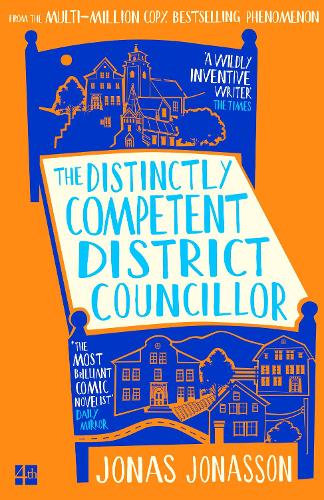
The Distinctly Competent District Councillor – by Jonas Jonasson

16 06 2026

As a big fan of Jonas Jonasson, I was excited to get his latest book for my birthday – what I didn’t realise was how much shorter it is than his other books so far at only ~130 pages!

He explains in the opening note to readers, why he wrote this book at this time:

“The times we live in are anything but simple, with war and conflicts everywhere, and it was for this reason that I felt the urge to write something that might give us hope. I wanted to write about friendship between people from different nations. Between my Swedish compatriots, for example, and the Germans, of whom I have grown very fond in recent years. And what came out was this story about a small town in Sweden where things are difficult: unemployment, young people moving away – even the local bookshoop has had to close. It doesn’t get much worse than that! But when blue and yellow meets black, red and gold, things finally start looking up…
With this in mind, I hope you enjoy my small contribution to German-Swedish friendship. Happy reading!”

So, from the blurb:

“All over the world, people sleep blissfully in Traumbett beds. These marvellous feats of German engineering have successfully cornered the mattress market everywhere. Everywhere, except Sweden and owner Konrad Kaltenbacher Jr is desperate to expand there.
With Konrad Jr’s sights set firmly on stylish Stockholm, Julia Bäck, district councillor of the small, decaying town of Halstaholm, has plans of her own. Seeing an opportunity to attract 800 new jobs, Julia jumps into spearheading a persuasive campaign to win the contract. A roundabout is hastily renamed in honour of Angela Merkel; a German school is quickly established under the leadership of a ten-year-old boy and three elderly pensioners; and the town swimming poo is rapidly transformed into a beerhouse – it had been empty for years anyway!
Julia’s get-up-and-go impresses the German boss… but has she made herself a tricky bed to lie in?”

It didn’t feel quite as wild and wacky as his other books, probably mostly due to the length, but if you hadn’t read his other stuff, you’d definitely still think it was a bit out there!

There were a few confusing moments when the book had to specify something was said in English, since they’re translated from Swedish, clearly in the original it would have been obvious, but for us, far less so!

A couple of standout lines:

  • ‘”Have you thought this through, dear?” she added.
    “No,” said the mayor. “When would I have had time for that?”‘
  • ‘There’s plenty wrong with me, I will admit. Just ask the fish in my aquarium at home, he knows. Or maybe he’s a she? I have no idea. It might be better not to know; he or she doesn’t talk, anyway. Autistic, is my guess.”‘
  • And just a wonderful moment when someone is requested to get a statue of Franz Beckenbauer, a famous German footballer, but none are available, so they’re just told to get another German: “It doesn’t matter who, as long as he’s famous”, so you can guess what direction that goes in….


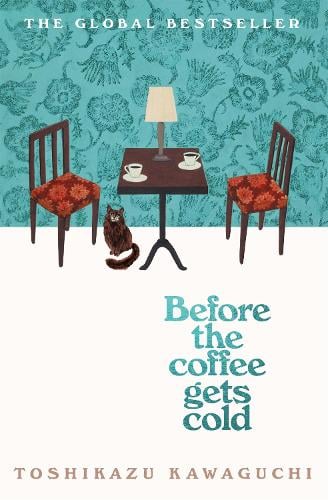
Before the coffee gets cold – by Toshikazu Kawaguchi

8 06 2026

I feel like this book was everywhere about 5 years ago, and now I’ve finally got around to reading it after needing something to top up a Waterstones order to get free delivery!

From the blurb:
“In a small back alley in Tokyo, there is a cafe which has been serving carefully brewed coffee for more than one hundred years. But this coffee shop offers its customers a unique experience: the chance to travel back in time.
In
Before the coffee gets cold, we meet four visitors, each of whom is hoping to make use of the cafe’s time-travelling offer, in order to confront the man who left them, receive a letter from their husband whose memory has begun to fade, see their sister one last time, and meet the daughter they never got the chance to know.
But the journey into the past does not come without risks: customers must sit in a particular sear, they cannot leave the cafe, and finally, they must return to the present before the coffee gets cold…”

One of my favourite things about this book I discovered before I even started – in the front of the book is a relationship map of characters! This was so useful, showing who everyone was, and how they linked together. Particularly useful in this case as the names being Japanese were less familiar to me, and a lot began with K, so it was easy to confuse them while settling into the story. More books need this!

So the rules of the cafe are thus:
1. The only people one may meet while back in the past are those who have visited the cafe
2. No matter how hard one tries while back in the past, one cannot change the present
3. In order to return to the past, you have to sit in that seat and that seat alone
4. While back in the past, you must stay in the seat and never move from it
5. There is a time limit, you must return before the coffee gets cold
6. A person who has sat on the chair to travel through time once cannot do it a second time. Each person receives only a single chance

The book is divided into four chapters, one for each scenario, but the characters are all interwoven throughout so where I wondered if it might read as a set of short stories, it didn’t, there was flow throughout with all the characters knowing each other and being in the cafe for various reasons, and each had a flashback or two to share some backstory.

I’m not sure I’d read the rest of the series, I guess it depends how they work, whether it’s another set of characters and their stories, further travels with these characters, or something else entirely. But it was a really nice idea and I enjoyed it.


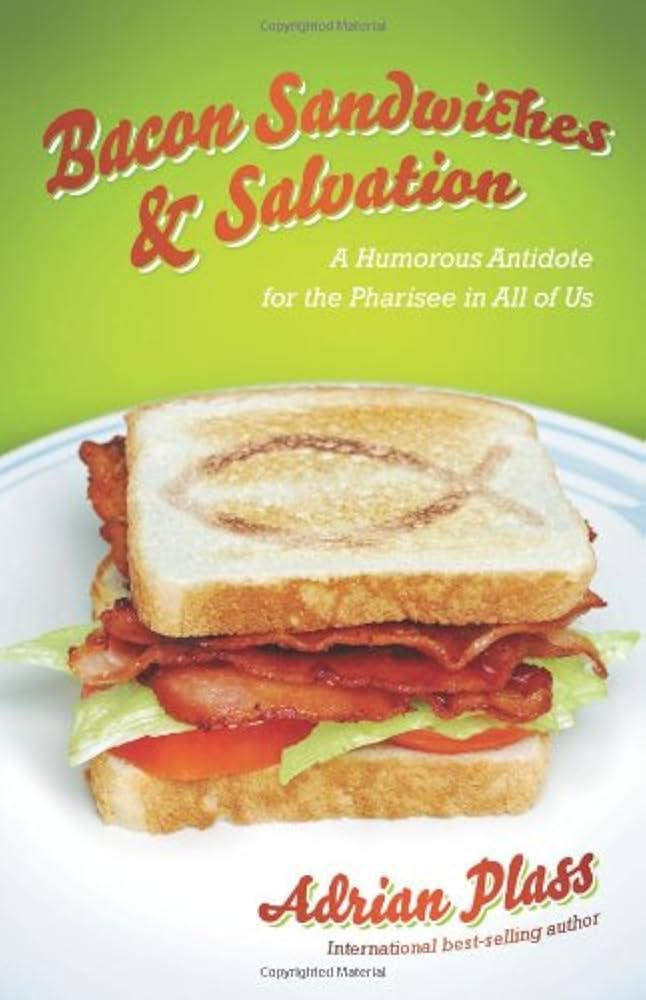
Bacon Sandwiches & Salvation – by Adrian Plass

25 05 2026

I’ve always been a fan of Adrian Plass‘s writing, he always feels very down to earth with his humour. I even met him once and he said he wanted to swap lives with me (because I was in my early 20s at the time)! This book I didn’t love as much as some, it’s still funny, it’s still got stuff to make you think, but it felt a bit confused of its own identity. But I’m getting ahead of myself.

The book is done in the format of a dictionary (or a glossary? what’s the difference?!) of Christian terminology, but when you go to read it, most of it is not serious. There are play on words, a good number of anagrams, silly observations about Christian culture, and then every now and then, a multi page anecdote which is quite tenuously linked to whatever the word was. They’re fun to read, but this is where I find the book a bit confusing about what it’s trying to be.

I did enjoy it, but over the bank holiday weekend I kept finding myself reading it, but more so that I could finish it and start something else. It was hit and miss for sure, some of the hits are below, the misses are what made me want to finish.

I really did enjoy some of his re-written song lyrics, a couple of examples below (bearing in mind this was published 20 years ago and the songs needed to be easily familiar to the reader, they’re all 20th century (or older?!))

  • “The name of the Lord is
    A strong tower
    The righteous run into it
    And bang their heads”
  • “And can it be, that no one was concerned
    When I staggered in with an awkward lurch
    If they had asked me, they might have learned
    I came of my bike on the way to church
    My chain came off
    I swerved into a tree
    I smashed my shin
    And grazed my knee
    My chain, my chain came off….”
  • “Father God I wonder
    why they bother with a speaker
    when they have a worship leader
    who’s as wonderful as me.
    Now they won’t be needing
    all that Holy Spirit leading
    they have asked for twenty minutes
    but my kind of talent knows no limits.
    I will sing for ever
    I will sing for ever
    I will sing for ever, for evermore.”

And then some of the other bits that caught my attention

  • Alpha: outreach system that has brought thousands to faith, but has left in its wake a small, deeply confused group of people who have mistakenly asked Nicky Gumbel into their lives.”
  • Ashurbanipal: a name slipped into the fourth chapter of Ezra by God for the purpose of preserving humility in those who think they are such good sight readers that they don’t need to prepare the Sunday lesson.”
  • Good Samaritan: fictional biblical character in a parable told by Jesus. Claimed as Tory by the Conservatives because his investments had provided sufficient resources for him to be able to help if he so wished, as a socialist by the Labour Party because he was actually willing to share his money, and by the Liberal Democrats because the crowd that was listening to the parable automatically assumed that he would be useless.”
  • Grace: prayer said before meals by most Christians when fellow believers are visiting and by rather fewer when they are not.”
  • Human beings: the main reason for God sending his Son and, coincidentally and ridiculously, the main obstacle to the fulfilment of his plan.”
  • Nation word that, for some reason, is almost invariably used in formal Christian situations instead of the word “country,” presumably because “nation” has a more monumental and significant ring to it.”


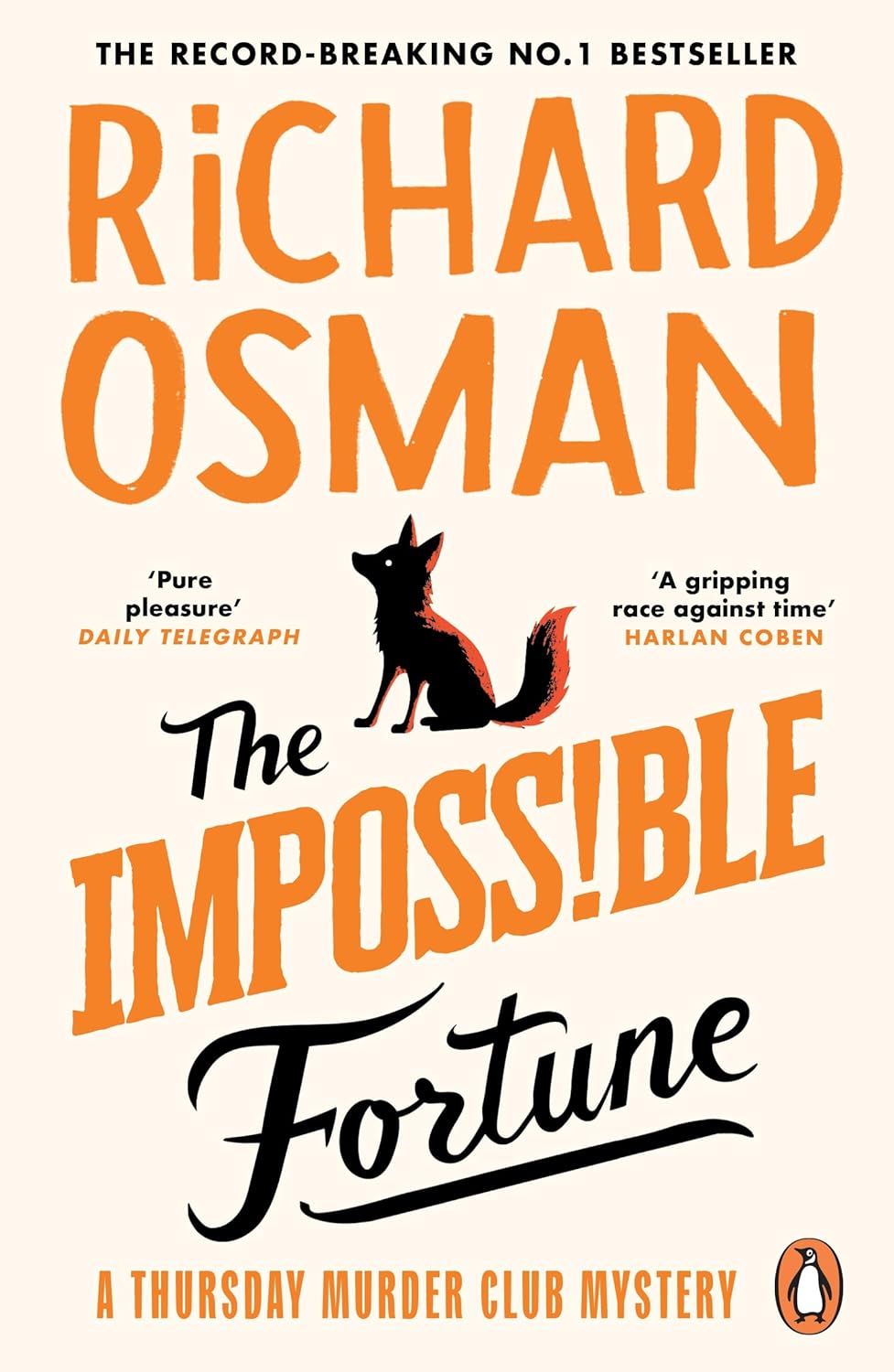
The Impossible Fortune – by Richard Osman

19 05 2026

So we reach the fifth book in the Thursday Murder Club series, and I think it’s been my favourite so far! There’d been a two year gap since the fourth book was released, and so after such a long time away, just within a couple of pages of starting I felt all warm and fuzzy, realising how I’d missed the characters, particularly Joyce!

The book start’s with Joyce’s daughter Joanna’s wedding, but within 24 hours we have a missing person, a dead person, and $350m worth of bitcoin at stake if only they can work out how to get hold of 2 parts of a code.

This sounds very dramatic, but of course, it’s Thursday Murder Club, so as well as plenty of excitement, there’s also plenty of mundane and lovely moments, and of course some excellent little lines.

  • “If we have different ideas about gluten, we’re going to have different ideas about most things.”
  • “That’s the problem with going out. One thing leads to another, and you find yourself going out again.”
  • “She remembers when Dan Hatfield had two arms. The money he’d wasted on tattoos on that other arm.”
  • “Rightmove teaches you an awful lot about the world, and also a lot about people’s taste in curtains.”
  • “That must be the world’s shorted honeymoon […] I feel like Liz Truss.”
  • “Amazon deliveries have been the single greatest boon for professional hitmen. Everyone is always expecting one.”

I’m just sad it’s another two year wait ’til the next one now, they’re such a fun gang to hang out with!


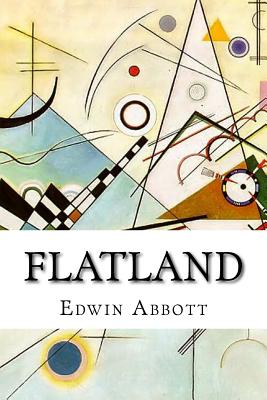
Flatland – by Edwin Abbott Abbott

9 05 2026

This is a weird book. It’s a novella, set in a two dimensional world, narrated by a square. In the first half of the book he explains how their world works, in the second he talks to both the king of Lineland (a one dimensional world) and a sphere from Space (the three dimensional world). Obscure enough for you yet? Well take all that, and then skew your head around it being written in 1884, Victorian times. Bizarre!

So in Flatland all people are shapes, which is how class is decided. The lowest class are triangles, and the more isosceles, the lower they are, all the way through to polygons with so many sides they appear to be circles, these are the highest class of people. All shapes beyond triangles must be regular, or else will likely be banished from society. But we must remember that this was written a very long time ago, and so the exception to the above is women; all women are single lines, which tells you a lot about how they’re talked about in this book eg “they are consequently wholly devoid of brain power”, though at times they are also referred to as “formidable”, and “by no means to be trifled with” thanks to the sharp end of their line, sharper than any man’s angles.

Now, since it’s two dimensional, all you can see is one dimension (in the same way that in our three dimensional world, we see two dimensions), and so all these different shapes, at first glance look like just lines. They identify each other either by feeling, or with a bit of depth perception since there is normally a slight fog or mist. This is all explained in the book in a LOT more detail! You may wonder why they can’t be identified by some colour change or design, well, they used to, but there were problems with people faking their colours, and so now all colours are banned.

You may be spotting many holes in how life might work in a two dimensional world, and handily, these are skipped right over as our narrator, the square, decides it’s high time he moves on to the next section of the book, and so says he won’t have time to cover “our method of propelling and stopping ourselves, although destitute of feet; the means by which we give fixity to structures of wood, stone or brick, although of course we have no hands, nor can we lay foundations as you can, nor avail ourselves of the lateral pressure of the earth; the manner in which the rain originates in the intervals between our various zones, so that the northern regions do not intercept the moisture from falling on the southern; the nature of our hills and mines, our trees and vegetables, our seasons and harvest; our Alphabet and method of writing, adapted to our linear tablets; these and a hundred other details of our physical existence I must pass over.”

So that’s the first half dealt with! In the second, he first meets the Monarch of Lineland, and tries to explain to him life in two dimensions, which he obviously cannot understand, any more than we could understand what a world with four dimensions might look like. In Lineland, they can’t pass each other to get anywhere, but he explains that they can communicate over thousands of miles by sound, even to the point of impregnating, which requires one man and two women, and will always produce three children in that same ratio to preserve how that society works.

Following this, a sphere intersects the plane of Flatland and tries to explain life in two dimensions to the square. The irony of the conversation being the same with the same frustrations at not being understood now the show is on the other foot, is quite funny, but eventually the sphere is able to bring square out of Flatland into Space, and show him!

Then comes his return to Flatland, and his attempts to convert folk to the Gospel of the Three Dimensions, but this is an imprisonable offence….

What did I tell you – weird! Just feels way too abstract for something of that era, though I guess it’s not far off Lewis Carroll, and he wrote some weird stuff too….


Charlotte’s Web – by E.B. White

25 04 2026

I never read this as a kid, and found it at a book fair in a 3 for £1 deal, so thought I’d give it a go! Other than know it was about a girl, a pig and a spider, I had zero idea of the plot!

The opening is brutal, given it’s a children’s book – “Where’s Papa going with that axe?” it turns out, he’s off to kill the runt of a litter of pigs born last night. What a start! Well Fern (the girl on the front cover) begs him not to, and raises the pig, Wilbur, on a bottle. Other than this bit at the start, I’d argue Fern is made a bit too much of, the bulk of the story is about Wilbur, Charlotte the spider, and the other animals in the barn, while Fern just starts to take an interest in boys. I’m not sure she deserves to be on the front cover!

One thing I struggled with (and I’m aware this sounds stupid) is that while I was very happy to suspend my disbelief insofar as animals talking is fine, but when, a few times in the book, Wilbur did a backflip, occasionally with a half twist, that seemed a bit ridiculous to me. Yes, I heard myself, ridiculous double standards!

Towards the end of the book there is a very sad moment, *spoiler alert* where Charlotte sadly passes away. There’s a line that’s a proper punch in the stomach as the chapter closes – “No one was with her when she died.” But it’s a children’s book, so it still finishes on a positive and we all end happily.


Tender – by Harry Baker

18 04 2026

I’d already heard some of these poems performed when I saw Harry live last year, but was keen to read the rest, and support his work!

When his son was born, he wrote a poem every day for the first 100 days to help remember that time, and this is a book of all of them, some very moving, several funny, it’s a real mix, and enjoyable!

Favourites would include one about taking the opportunity to have dinner with his wife while the baby sleeps, but they only have poppadums and mango chutney, and how to do that quietly so it doesn’t wake him, also one about his first time seeing a horse. There’s also a wonderful one nearer the end about what various celebrities were doing in 1958.


Revolting Rhymes – by Roald Dahl

6 04 2026

Several years ago I worked through the box set of Roald Dahl’s children’s books, and had the best time! Last week I was at a book sale where I found a copy of Revolting Rhymes, which I’d never read, and looked a lot of fun – turns out it was!

The book contains Dahl’s takes on Cinderella, Jack and the Beanstalk, Snow White and the Seven Dwarves, Goldilocks and the Three Bears, Little Red Riding Hood, and the Three Little Pigs. But none of them are quite as you remember them, they have twists, generally much darker, that mean the stories all have different endings to normal, be it beheadings, guns, or becoming as rich as they like, it’s all in rhyme as you’d expect from the title, and a lot of fun!


Alternate Endings – by Erin Bolens

24 02 2026

As part of my Harry Baker binge last year, I went to see one of his Christmas shows in Leeds, at which Erin performed. She shared some of her Worry Doll poems, which were just so so funny, I had to buy her book as it contained nine of them!

As far as the rest of the book went, it was more what I think of when I think of poetry, that is, a bit too clever for me. There were a few I enjoyed, but really I just loved the Worry Doll ones, and it was worth it for them alone.

I enjoyed ‘River’, which pointed out we’ll have a picnic on the side of a river but not a motorway, nor will we get a round trip in a taxi for fun.

The Worry Doll poems cover all sorts of things, from what to wear to the doctors, to how much effort to put into your appearance for the postman, but my favourite was Worry Doll II, on the theme of feminine hygiene and the environment!

I’m never sure if it’s ok to re-type out a whole poem, below I’ve typed out the first half, but very happy to remove if requested.

Worry Doll II
I worry about my effects on the environment. I decide to stop using tampons and pads. I Google menstruation cups. That’s a minefield. There are different sizes. And shapes. I don’t know what size or shape my vagina is. I’ve never really seen it that way; no one has ever told me. It appears important to know how high your cervix is. I’m not entirely positive I’m 100% sure which bit the cervix is. I worry I don’t know enough about my vagina. I worry my lack of knowledge about my vagina is impacting negatively on the environment.
[…]


The Anthropocene Reviewed – by John Green

21 02 2026

Several years ago I worked my way through John Green’s fiction writings, then more recently I was recommended his podcast and youtube channel, both run with his brother, also author, Hank Green. I’ve enjoyed their chatter, and when I heard about this book I thought it’d be an interesting read, very different from his other stuff.

Let’s start with a definition, the Anthropocene is a proposed term for the current era of Earth’s history. This book comes out of a podcast of the same title, and is a set of essays which are all fundamentally reviews of different things, as Green used to write book reviews for a living before he became an author.

Some chapters were more serious than others, I think I’d assumed the whole book would be a bit more tongue in cheek, which is maybe why I didn’t give it as high a rating as I expected to. I learnt about some really interesting things, such as the Lascaux cave paintings, and the Champion’s League final 2005. There were also chapters on Diet Dr Pepper, Scratch’n’Sniff stickers, and the world’s largest ball of paint.

My paperback edition had a couple of extra bonus essays at the back, one of which felt very much like it was repeating an earlier story he shared, but who knows if it was just something I’d recently heard elsewhere as it wasn’t personal to him!

Of course, there were quotes to repeat:

  • “Never predict the end of the world. You’re almost certain to be wrong, and if you’re right, no one will be around to congratulate you.”
  • “Humans are already an ecological catastrophe […] for many forms of life, humanity is the apocalypse.”
  • “It’s no coincidence that the scientific revolution in Britain coincided with the rise of British participation in the Atlantic slave trade and the growing wealth being extracted from colonies and enslaved labour.”
  • [Discussing how we can’t look directly at the sun] “In the Book of Exodus, God says, ‘You cannot see my face, for no one may see me and live.’ No wonder that Christian writers have for centuries been punning on Jesus as being both Son and Sun.”
  • “Colour is a fiction of light.” – Tacita Dean
  • “What’s news isn’t primarily what is noteworthy or important, but what is new.”
  • “It’s been my experience that almost everything easy to mock turns out to be interesting if you pay closer attention.”
  • “Cholera continues to spread and kill not because we lack the tools to understand or treat the disease as we did two hundred years ago, but because each day, as a human community, we decide not to prioritize the health of people living in poverty. Like tuberculosis, malaria, and many other infectious diseases, cholera is only successful in the twenty-first century because the rich world doesn’t feel threatened by it. As Tina Rosenberg has written, “Probably the worst thing that ever happened to malaria in poor nations was its eradication in rich ones.”
  • “Even the most extraordinary genius can accomplish very little alone.”
  • “Almost everything turns out to be interesting if you pay the right kind of attention to it.”