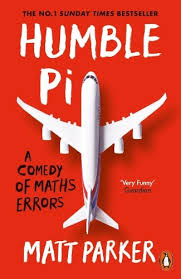
Subtitled, “A Comedy of Maths Errors”, this book takes you through common mistakes that have had huge impacts, but written in a light way that is easy and accessible to read.
From rounding errors to random numbers, from bridge building to medical treatment, all sorts of things are covered. It was so interesting!
Because it was a borrowed book (OK, I gave it to my Dad last Christmas, then borrowed it once he’d read it!), I didn’t turn down page corners, but still tried to make a note of some bits that were interesting or entertaining:
- “Our human brains are simply not wired to be good at mathematics out of the box. […] All humans are stupid when it comes to learning formal mathematics.”
- “A political committee is rarely a good solution to a mathematical problem.”
- “If you’re reading this before Wednesday, 18 May 2033 it is still coming up on 2 billion seconds [since 1 January 1970]. What a party that will be.”
- “We make things beyond what we understand, and we always have done. Steam engines worked before we had a theory of thermodynamics; vaccines were developed before we knew how the immune system works; aircraft continue to fly to this day, despite the many gaps in our understanding of aerodynamics.”
- “Just because something walks like a number and quacks like a number does not mean it is a number. […] If you’re not sure if something is a number or not, my test is to imagine asking someone for half of it. If you asked for half the height of someone 180cm tall, they would say 90cm. Height is a number. Ask for half of someone’s phone number, and they will give you the first half of the digits. If the response is not to divide it but rather to split it, its’ not a number.”
- “Age is systematically rounded down in many countries, a human age is zero for the first year of their life and increments to being one year old only after they have finished that whole period of their life. […] Which means that when you are thirty-nine you are not in your thirty-ninth year of life but your fortieth. If you count the day of your birth as a birthday (which is hard to argue against), then when you turn thirty-nine it is actually your fortieth birthday. True as that may be, in my experience, people don’t like it written in their birthday card.”
- “There is nothing you can do to increase your chances of winning the lottery other than buy more tickets. Wait – I should specify: buy more tickets with different numbers.”
- “In 2017 two researchers in Canada produced twelve sets of data which all had the same averages and standard deviations as a picture of a dinosaur. The ‘Datasaurus’.”
- “You can still buy books of random numbers online. If you have not done so before, you must read the online reviews of books of random numbers. You’d think people would not have much to say about lists of random digits, but this vacuum brings out the creativity in people.”
- “When I was a high-school maths teacher one of my favourite pieces of homework to set was to ask students to spend their evening flipping a coin one hundred times and recording the results. […] I could then take those lists and, by the end of the lesson, I had split them into two piles: those who actually did the homework […] and those who could not be bothered and just wrote out a long list of heads and tails off the top of their head.”
- “We all make mistakes. Relentlessly. And that is nothing to be feared. […] Mathematicians aren’t people who find maths easy; they’re people who enjoy how hard it is.”
 ineke.co.uk