The Official History of Britain: Our story in numbers as told by the Office for National Statistics – by Boris Starling

19 04 2025

This book was so much fun – I know you don’t get that from the title, in fact, it sounds *incredibly* dry, but I assure you, it’s a fun read! All sorts of cynical comments and random tangents make it a really easy read, all while being really interesting! There were jokes at the expense of Tottenham fans and the population of East Anglia, as well as random bits of trivia and at times, just following his train of thought wherever it went!

The book is split into 5 sections:

  • The first three look at how things have changed over the last 200 years that regular censuses have been taken (Who we are, what we do, where we are)
  • The fourth is a focus on the 1921 census, which was just after the Spanish Flu, and given this was written in 2020 in the depths of the pandemic, a lot of comparisons are drawn.
  • And then finally an imaginative look ahead to what the 2121 census might look like, both in results, and how it’s achieved.

I really wanted to give this 5 stars, but there were just a few mistakes that meant I couldn’t do that: Categories mislabeled on a graph key, black and white diagrams with shades of grey too similar to decipher, and tables which didn’t show units, making them confusing to interpret. as well as one instance of talking about a value decreasing and then showing it increasing….. other than that, brilliant!

I’d be really interested in reading a re-issue of this now that we’re out of COVID (for the most part), with a bonus chapter or two looking at how it affected things as a lot was made of what effect it might have, but at the time of writing, it was too soon to tell.

As it is, it was bookended with this quote from Lord Kelvin: “If you cannot measure it, you cannot improve it”

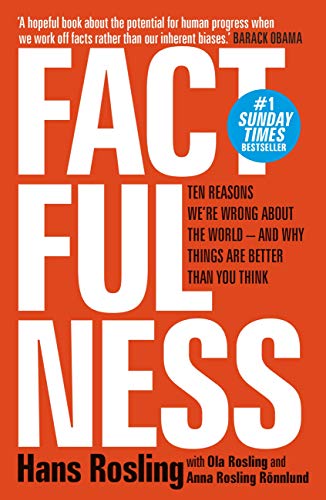


Factfulness – by Hans Rosling

24 02 2020

There is a reason that on the front of this book is a recommendation from Barack Obama, and on the back, from Bill & Melinda Gates. It’s a very good, and very important book. I’d already heard of Hans from his TED talks, if you’re interested, some of his most viewed ones are at the bottom of the page.

We have a tendency to refer to the developed and developing world, but really the world is divided into more than these two categories, it’s more complicated. He gives us four levels, levels one and four are what we’d traditionally refer to as the first and third world, but this is the minority of the worlds population, he tells us that about five billion people actually live on levels two and three, maybe they have a camping stove to cook on rather than a fire, maybe a moped rather than getting everywhere on foot. He gives a thorough explanation of these levels, more than I can here, along with photos to help cement the idea. You can find a large selection of these on their Dollar Street website.

The subtitle is: “Ten reasons we’re wrong about the world – and why things are better than you think.” Hans takes us through ten instincts we all have about the world, which are outdated, or were never the case at all. For example, the gap instinct, that the world is divided into the rich and poor and that there is no one in the middle, which as explained above is not the case at all, in fact, the majority are in the middle. Or that just because things are bad, it doesn’t mean they’re not improving; things can be bad but better than they were.

The book is filled with these really interesting ideas, and each chapter ends with a helpful summary page, highlighting what the issue with the instinct is, and tips to avoid it, which I’m sure I’ll be referring back to!

I have folded down so many pages of this book that I won’t list all the quotes here, but along with that I already have a queue of people to borrow my copy! I normally really struggle with non fiction and would expect this to take a good few months, but it was only 2.5 weeks! While it’s a data-y book, it’s got graphs (his favourite is here, and a live animated version like those in the videos below, you can play with on their Gapminder website) and things to help understand, and is written in a conversational style, full of anecdotes, and is very easy to read.

I’d recommend this book to anyone interested in the state of our world, and facts to back that up, as well as those just wanting to be able to assess information they receive better.