How to get good pictures of your dog
Fictional characters who portray mental illnesses
Fascinating and detailed theory on different levels of friendship

How to get good pictures of your dog
Fictional characters who portray mental illnesses
Fascinating and detailed theory on different levels of friendship
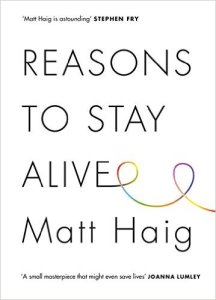
This book is brilliant, everyone should read it, it should maybe even be on the National Curriculum.
I believed this before I even read it. The quotes on the front, back, and inside covers set the bar very high indeed – here are a couple of my favourites:
And they’re correct. Technically an autobiography, we travel with Matt Haig through his experience of anxiety and depression, through five sections: “Falling”, “Landing”, “Rising”, “Living” and “Being”.
One of my favourite things about the book is that I don’t think there was a chapter longer than 6 pages, and most chapters were 1-4 pages – it’s well and truly bite-size, which is handy for something that while massively educational for some, has the risk of being triggering for others. It’s not a long book either – it’s quite small in size, well spaced, and only ~250 pages, so really not too intimidating. For what can be a very heavy subject, it’s broken down brilliantly.
For me this book had two very different sides to it. I’ve said before that I have anxiety disorder, and so for that section of the book, I was reading him put into words things I’ve felt but never been able to explain, and just reading about others that have the same struggles is encouraging in knowing you’re not alone. The other half, depression, I have friends that struggle with this, but don’t know a tonne about it myself, and so for this side of the story, it was hugely educational. As someone experienced, and someone clueless, this book had something to say to me.
Some chapters are simply lists: How to be there for someone with depression or anxiety, Things that (sometimes) make me better, and of course, Reasons to stay alive, among many others. There’s also a further reading list at the back.
I’ve put some of my favourite nuggets below, but please please read this book.
Website shows what it’s like to have dyslexia
Friends quotes that have become day to day phrases
Unexplainable joys of Britishness
Some of the stupidest IT support questions!

“You shall not steal.”
We live in a corrupt world. Corruption is responsible for about 5% of the global GDP.
We pay the price in insurance, tax, higher prices in shops to cover losses from shop lifting..
Tax avoidance is a huge issue for respectable companies – fraud is theft!
Some forms of theft have almost become normal or even acceptable. Dream holidays that are building sites, taking office stationary, even wasting work time.
A lot of the ten commandments tie together. Theft (8) often stems from coveting (10), can hardly be done without lying (9) and often ties in with idolatry (2).
Consumerism is a religion, shopping centres are the new cathedrals.
“No one can serve two masters. Either you will hate the one and love the other, or you will be devoted to the one and despise the other. You cannot serve both God and Money.” – Luke 16 v 13
The desire to acquire, to keep up with others, is a danger of consumerism.
“Yours, Lord, is the greatness and the power
and the glory and the majesty and the splendour,
for everything in heaven and earth is yours.
Yours, Lord, is the kingdom;
you are exalted as head over all.
Wealth and honour come from you;
you are the ruler of all things.
In your hands are strength and power
to exalt and give strength to all.
But who am I, and who are my people, that we should be able to give as generously as this? Everything comes from you, and we have given you only what comes from your hand.” – 1 Chronicles 29 vv 11-12, 14
People have their wealth and possessions, but we’re stewards, not owners. Stealing is therefore an offence against God – it implies the robber is not trusting God for all he needs.
A steward is someone who cares for someone else’s property and manages it to their intentions, not being wasteful or letting it get into disrepair.
Good stewardship means working hard – “Anyone who has been stealing must steal no longer, but must work, doing something useful with their own hands, that they may have something to share with those in need.” – Ephesians 4 v 28
Good stewardship involves giving away to those in need
Three attitudes to possessions:
“Do not store up for yourselves treasures on earth, where moths and vermin destroy, and where thieves break in and steal. But store up for yourselves treasures in heaven, where moths and vermin do not destroy, and where thieves do not break in and steal. For where your treasure is, there your heart will be also.” – Matthew 6 vv 19-21
Our gifts and talents are from God and are to be used for His glory. When we waste time and fail to use gifts we’re robbing God.
Breaking other commandments robs God of his glory, and so in breaking them, we often break this one.
When we steal, we are saying that what God has given us is not enough.
If last year’s Eurovision was run with this year’s scoring system
Where is your surname popular?
Much as I hate to admit it, there are some plot faults in Cinderella
Hilarious take on the Lion King – no seriously, I actually laughed out loud a few times, but warning, does contain swears
A surprisingly excellent reason why a dad is going to get his baby a tattoo
A company is giving women “period leave”

This is definitely one of those books you can’t put down. This week I’ve taken it pretty much everywhere with me, just incase I could find 2 minutes to read a bit more.
We meet Louisa who needs a new job, and ends up as a minder/carer sort of role for Will, who is a quadriplegic which basically means he only has use of his neck and head, and ever so slightly one thumb. Will is incredibly bitter about the life he now faces compared with the lifestyle of a rich city boy that he had become used to, and Louisa’s role is to convince him that life is worth living after all.
Most of the book is written in the first person from Louisa’s point of view, but a few of the other main characters get one chapter to speak throughout the book – her sister, the medical carer, and each of Will’s parents. I found it confusing at times because I’d pick up the book halfway through a chapter and forget someone else was speaking, but it was good to round out the picture a little.
I got so involved with the characters as I read this book, getting angry at some, feeling sorry for others, and wanting to give them a hug when things were tough. Jojo Moyes really is an excellent writer! I can’t wait to try the sequel…

“You shall not commit adultery.”
I went to our early service this week, which means these notes are from a different speaker than usual, but still on the seventh commandment!
Marriage was God’s idea right from the start.
“That is why a man leaves his father and mother and is united to his wife, and they become one flesh.” – Genesis 2 v 24
It wasn’t long before they thought they knew better. We have free will, so it’s no surprise we struggle.
Adultery can be committed mentally as well as physically.
“But I tell you that anyone who looks at a woman lustfully has already committed adultery with her in his heart.” – Matthew 5 v 28
We live in a very sexualised culture. Not just in things that make sense to be romantic, but absolutely everything!
Our hearts may be given to the Lord, but we’re still susceptible – thoughts go round our head.
“Finally, brothers and sisters, whatever is true, whatever is noble, whatever is right, whatever is pure, whatever is lovely, whatever is admirable – if anything is excellent or praiseworthy – think about such things.” – Philippians 4 v 8
It’s about thought life. Thoughts lead to feelings lead to behaviour. Thoughts work their way outwards.
External influences are important too. Be careful what you put in, because it tends to start to come out.
We should also consider spiritual adultery.
Adultery is by definition an act of unfaithfulness, and so spiritual adultery is an act of unfaithfulness in our relationship with God.
Hosea was told to marry a woman who would be unfaithful, symbolising Israel’s behaviour.
“you have forsaken the love you had at first.” – Revelation 2 v 4b
We will make mistakes, but God is gracious.
“You see the depths of my heart and you love me the same” – Indescribable, by Chris Tomlin
We shouldn’t treat our relationship with God lightly or carelessly. The enemy is looking for any way to trip us up.
Four words even clever people get wrong
Helpful info on the referendum
EU Referendum debate to be held at Wembley


“You shall not murder.”
In the original Hebrew this commandment is two words: “Don’t kill”. The Hebrew language has 8 words for killing. This one is forbidding unlawful killing of a human being.
For further reading on the subject our Pastor recommended “Issues facing Christians today” by John Stott.
Life is valuable and comes from God. He is the author of life, He gives and takes away: “Then the Lord God formed a man from the dust of the ground and breathed into his nostrils the breath of life, and the man became a living being.” – Genesis 2 v 7
Issues of Life and Death:
All of these subjects are complex and require further reading than can be covered in a sermon. For anyone who has broken this commandment though, there is forgiveness available.
It’s much harder to keep this commandment than it initially seems.
“You have heard that it was said to the people long ago, “You shall not murder, and anyone who murders will be subject to judgment.” But I tell you that anyone who is angry with a brother or sister will be subject to judgment.” – Matthew 5 vv 21-22a
Jesus raised the bar substantially. These are the things in our lives that can become seeds of much greater issues.
It’s ok to be angry about injustice in this world – we want to share God’s heart. How could God be indifferent to the freezing Syrian children?!
When there is damage in a relationship there may be anger, and it needs dealing with. “In your anger do not sin” – Ephesians 4 v 26a.
Often our anger is tied in with a desire for revenge, that is not ok.
There are four unhealthy ways in which we express anger
We’re capable of any of these!
“My dear brothers and sisters, take note of this: everyone should be quick to listen, slow to speak and slow to become angry” – James 1 v 19
This indicates that we will become angry.
When we are angry with someone we should go to them, but not to explode at them. It’s biblical to describe the hurt we feel and talk it through. We should do this before coming to the Communion table.
It’s not easy! We’re works in progress, and need to work on it.
The bible teaches us not to take revenge or bear grudges.
“See to it that no one falls short of the grace of God and that no bitter root grows up to cause trouble and defile many.” – Hebrews 12 v 15
“For if you forgive other people when they sin against you, your heavenly Father will also forgive you. 15 But if you do not forgive others their sins, your Father will not forgive your sins.” – Matthew 6 vv 14-15
When we’re looking to deal with a broken relationship we need to do it slowly and humbly.
We’ve all broken this commandment, Jesus never did. Through Him we find forgiveness.
Unwritten rules of social interaction that should be rules
What should have happened in Finding Nemo
Children drew inventions, scientists made them!
Massive changes to Eurovision voting
Excellent examples of extreme laziness


 ineke.co.uk