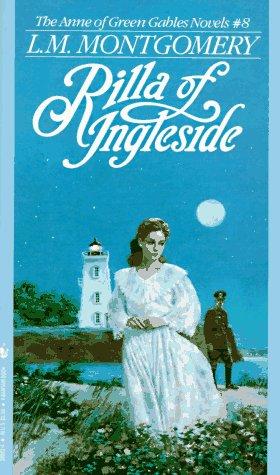
The final book in the Anne of Green Gables series, this felt quite different to the rest, in that it’s set from the eve to the end of the First World War. Like the previous book, while Anne is still in this, the focus is not on her, this time we’re mainly following Rilla, her youngest daughter, who is now 15 – she wasn’t in Rainbow Valley much as she was too young to play out with the older children, and so they are young adults.
When war starts, the oldest Blythe and Meredith boys enlist, and as time passes, some of the others get old enough to head off too, leaving behind the young women, some of whom have become sweethearts. Early on, Rilla, who ’til now has been rather self-involved, comes across a newborn baby whose mother has died, and whose father is away at war, and so she takes him in to raise herself, which obviously comes with its challenges.
I found it really interesting that a man in the village who is somewhat pro-German is referred to as a pacifist. He’s obviously seen as an awful person, but to me, pacifist is something really quite different!
It’s a book that have a real heaviness to it, but still has it’s moments of levity (and yet more Methodist bashing!), I really loved this book, and watching Rilla grow.
And now as I’ve finished the series I’m just sad that there are no more books for me to discover. I’ve enjoyed the characters of this series so much, Anne is obviously the main body of the stories, and even though these last two haven’t been about her so much, the books are still as wonderful.
As per usual, some quotes I noted:
- “Why couldn’t they have called her by her first name, Bertha, which was beautiful and dignified, instead of that silly “Rilla”?”
- “Some calls are visits, and some are visitations, […] dear.”
- “He is […] very nice and clever, and would be quite handsome if it were not for his nose. It is a really dreadful nose.”
- “I don’t wonder babies always cry when they wake up in the night. Everything presses on my soul then and no cloud has a silver lining.”
- “We are told to love our enemies, Susan” said the doctor solemnly. “Yes, our enemies, but not King George’s enemies, doctor dear.”
- “I used to hate Methodists, […] but I don’t hate them now. There is no sense in hating Methodists when there is a Kaiser or a Hindenburg in the world.”
- “”Do you know, Mrs Blythe […] what I would like to do to the Kaiser if I could? […] I would like to turn the Kaiser into a good man – a very good man – all at once, if I could. That is what I would do. Don’t you think, Mrs Blythe, that would be the worstest punishment of all?” […] He would understand how dreadful the things he has done are and he would feel so terrible about it that he would be more unhappy and miserable than he could ever be in any other way. He would feel just awful – and he would go on feeling like that forever.”
- “If the Almighty had meant us to fly he would have provided us with wings.”
- “Some men, I am told, consider a little preliminary courting the proper thing before a proposal, if only to give fair warning of their intentions.”
- “Compared with Germans, even Methodists seem attractive to me.”
- “There is nothing like acting sensibly in an emergency.”
- “I am going to take a honeymoon to celebrate the peace.” “A honeymoon, Susan?” “Yes, […] I shall never be able to get a husband, but I am not going to be cheated out of everything and a honeymoon I intend to have.”



 ineke.co.uk