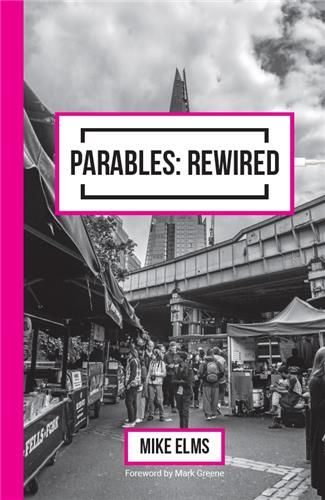
Parables: Rewired – by Mike Elms

15 02 2025

I don’t normally include devotional books here, but I really enjoyed this, and wanted to share it! I was going to try to explain it, but the blurb from his website does it better than I ever could:

“Jesus was passionate about getting his message across.
So, he used storylines based on everyday life to create stories that true faith-seekers could understand and relate to.
But, if Jesus were to tell these stories to you and me today, here and now, surely he would root them in our 21st Century culture of entertainment, media, technology, commerce, sport, medicine, social protocols.
Of course he would; and he would use these as everyday analogies and storylines to communicate his eternal, spiritual themes.
He would keep the themes and messaging of his parable stories unchanged, but he would wire his words into today’s world.
And so, in this book, the ‘Good Samaritan’ becomes the ‘Compassionate Millwall Fan’; and the ‘Lost Sheep’ becomes the ‘Missing Pupil’.
In every case, I also include the original parable as Jesus told it: I freely acknowledge that he was a better storyteller than me!”

So, there you go, loved it, give it a go!

My only disappointment is that at the end he references a similar job he’s writing on Proverbs, “due out in 2022”, but I can’t find any evidence of its existence, maybe it’ll happen one day!


Lent

22 02 2015

Gosh we’re much further into lent than I intended to be when I got this blog post written, over halfway in fact [handy tip: Mothering Sunday is always three weeks before Easter] but hey, what’s life without a little busy-ness?

I don’t think I’ve ever done the same thing for Lent twice, most things I don’t do anything, but over the years I’ve tried a few things

  • When I was probably about 14 I did the unthinkable and gave up Chocolate for 47 days. (Yes I know we think lent is 40 days, but actually that either a) doesn’t count Sundays or b) stops at Palm Sunday). Now those of you who know me will realise what a challenge this is – in writing this sentence I ate at least 10 giant chocolate buttons. But I managed it. On Easter morning I was very excited and went to eat some of that beautiful stuff, but the taste of it made me feel ill. At that point I said that having proven that I could do it, I would never give up chocolate for lent again, as I don’t want chocolate to make me feel that way! (Sadly I’m probably far more dependent on it now)
  • A year or two later I decided to take something up instead, and so first thing each morning I decided to drink a large glass of water to try and be a bit healthier. I did it and it was an easy one, but I don’t know that I really felt any benefit.
  • About five years ago I gave up something a bit less conventional, and a little more concerning that I felt it necessary… I gave up buying DVDs, or at least, DVDs for myself. I bought one DVD that Lent, for someone’s birthday, but again stuck to it. I just was going through a phase of using HMV and Amazon to get an awful lot of cheap DVDs, so felt it would be a good idea to stop for a bit.

This year however, I’ve been reading a daily devotional book by Maggi Dawn. I did her advent book at the end of last year and enjoyed it, so thought I’d give this one a go too, and on the first Friday of Lent, she shared some particularly interesting stuff about its history and purpose, which I thought I’d share with you here. (Obviously she puts it far more eloquently, but I’ve just summarised the bits that stood out to me).

  • Originally, the Lenten fast was not just about giving up luxuries, but everyday essentials. So, not only would you give up coffee, alcohol, chocolate, but also meat and all animal related products (eg milk, eggs, cheese). It was about giving up the things you depended on, so that verses like “Man shall not live by bread alone” – Matthew 4v4 were reality. We’ve made it into something about the individual, when it was always a full community exercise in the past.
  • Lent was also not about self improvement. We tend to give things up or take things up to cure a bad habit in ourselves, to lose weight, or to better ourselves, but originally it was just about understanding how our daily existence depended on God.
  • It’s not about impressing God either. No amount of fasting will change His view of us, He loves us anyway. This is about humbling ourselves.

Now I’m definitely not saying I’m about to go out and do this, but when Lent comes around and we all start to ask each other what we might give up, this really puts an interesting light on that conversation.