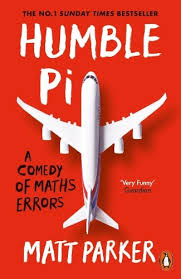
Humble Pi – by Matt Parker

26 12 2025

Subtitled, “A Comedy of Maths Errors”, this book takes you through common mistakes that have had huge impacts, but written in a light way that is easy and accessible to read.

From rounding errors to random numbers, from bridge building to medical treatment, all sorts of things are covered. It was so interesting!

Because it was a borrowed book (OK, I gave it to my Dad last Christmas, then borrowed it once he’d read it!), I didn’t turn down page corners, but still tried to make a note of some bits that were interesting or entertaining:

  • “Our human brains are simply not wired to be good at mathematics out of the box. […] All humans are stupid when it comes to learning formal mathematics.”
  • “A political committee is rarely a good solution to a mathematical problem.”
  • “If you’re reading this before Wednesday, 18 May 2033 it is still coming up on 2 billion seconds [since 1 January 1970]. What a party that will be.”
  • “We make things beyond what we understand, and we always have done. Steam engines worked before we had a theory of thermodynamics; vaccines were developed before we knew how the immune system works; aircraft continue to fly to this day, despite the many gaps in our understanding of aerodynamics.”
  • “Just because something walks like a number and quacks like a number does not mean it is a number. […] If you’re not sure if something is a number or not, my test is to imagine asking someone for half of it. If you asked for half the height of someone 180cm tall, they would say 90cm. Height is a number. Ask for half of someone’s phone number, and they will give you the first half of the digits. If the response is not to divide it but rather to split it, its’ not a number.”
  • “Age is systematically rounded down in many countries, a human age is zero for the first year of their life and increments to being one year old only after they have finished that whole period of their life. […] Which means that when you are thirty-nine you are not in your thirty-ninth year of life but your fortieth. If you count the day of your birth as a birthday (which is hard to argue against), then when you turn thirty-nine it is actually your fortieth birthday. True as that may be, in my experience, people don’t like it written in their birthday card.”
  • “There is nothing you can do to increase your chances of winning the lottery other than buy more tickets. Wait – I should specify: buy more tickets with different numbers.”
  • “In 2017 two researchers in Canada produced twelve sets of data which all had the same averages and standard deviations as a picture of a dinosaur. The ‘Datasaurus’.”
  • “You can still buy books of random numbers online. If you have not done so before, you must read the online reviews of books of random numbers. You’d think people would not have much to say about lists of random digits, but this vacuum brings out the creativity in people.”
  • “When I was a high-school maths teacher one of my favourite pieces of homework to set was to ask students to spend their evening flipping a coin one hundred times and recording the results. […] I could then take those lists and, by the end of the lesson, I had split them into two piles: those who actually did the homework […] and those who could not be bothered and just wrote out a long list of heads and tails off the top of their head.”
  • “We all make mistakes. Relentlessly. And that is nothing to be feared. […] Mathematicians aren’t people who find maths easy; they’re people who enjoy how hard it is.”
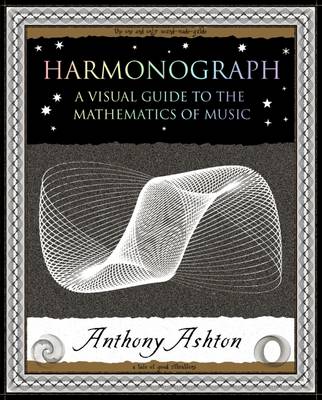


Harmonograph: A Visual Guide to the Mathematics of Music – by Anthony Ashton

30 12 2024

I’d wanted to read this for ages and got it for Christmas – it was shorted than expected, at around 50 pages, but also a much higher intellectual level than I expected.

My main issue is that I didn’t really understand one of the concepts that was used a LOT in the text. If there had been an extra page or two near the start to explain it a bit more, I think I could have loved it. It was talking about musical note differences in terms of ratios, so if anyone who’s into both music and physics can help me understand that a bit more, I’d then happily give it a re-read!

Either way, I was still able to follow bits of it, and they were interesting and also pretty!


The Indisputable Existence of Santa Claus – by Dr Hannah Fry & Dr Thomas Oléron Evans

29 12 2021

Maths & Christmas, what more could you want?!

From predicting the Queen’s Speech using Markov Chains, to how to wrap presents using the least wrapping paper, it covers all elements of the festive season! It’s nice and accessible too, with lots of notes for further reading for those who want to fully geek out (the number of articles that seem to have been written on cooking a turkey seems to be insane!)

It’s not a heavy book, lots of chatter and humour makes it easy to read, and lots of diagrams too, so you really fly through the 150 pages!


Numbers vs Maths

22 01 2019

I was always “good at maths.” At school, through til A Level’s it came to me easier than most other subjects, and I hugely enjoyed it – it wasn’t until university that it felt like a completely different subject that I just had no ability to do! I kinda assumed I’d just reached my limit, or I was an anomaly who just couldn’t handle the switch from working stuff out to proving stuff.

But on the way home tonight, I listened to this week’s Infinite Monkey Cage episode/podcast called “The Origin of Numbers.” During the last ten minutes or so, they said the following:

“I don’t know a single mathematician who’d say they were good at mental arithmetic.”

And it was like a revelation – I can do all the number bits, just the theory that I find hard. They talk about there being a distinction between numbers and mathematics.

They also talk about a condition called dyscalculia which they thought many mathematicians actually have, which is where you have problems with arithmetic. I feel like maybe I had the opposite to that!

So maybe, after all those years in education, I never was “good at maths”, I was good at numbers! I wonder if that explains why I am so into data, spreadsheets, processing, rather than any inclination at all to carry on in academia.

If you’re at all into maths or numbers, it’s a very interesting listen – go ahead!


A little bit of maths

31 12 2013

Last week it was my Dad’s birthday, and he turned the age of the year my Mum was born. We then realised that Mum was the age of the year Dad was born in. I thought a bit further and realised that when my Dad is the age of the year I was born in, then I’ll be the age of the year he was born in. It looked like this worked every time, but it seemed a good opportunity to work out why.

So I thought I’d de rust my brain and see if I could still do a mathsy proof – turned out it was ridiculously straight forward 🙂

define x=(year person a was born) mod 100
define y=(year person b was born) mod 100

person a reaches the age person b was born at year (x+y) mod 100
person b reaches the age person a was born at year (y+x) mod 100

we know x+y=y+x (e.g. call this z), so this will always happen at the same year

QED


Stats on Poverty: There are many reasons why I love this video

23 08 2013

If you haven’t checked out TED before, it’s a website full of short talks about all sorts of topics by all sorts of people, from a blind pianist, to mental health, there’s some great stuff on there – check it out!
Here’s one that I discovered today and is completely fantastic:

Reasons I love it

  • It is choc-a-block full of data and statistics with proper deep meaning
  • There are colourful graphs that move and show 4 dimensions of data in one go
  • The speaker commentates on the moving graph as if it’s a sport
  • There is a mass of information about the changes in world poverty over the last 40 years in all sorts of aspects
  • The man’s passion to make data more accessible to all by providing a link to make it more visual and less dull
  • The guy reminds me so much of one of my maths lecturers from uni with his accent and enthusiasm!

Definitely worth a watch!