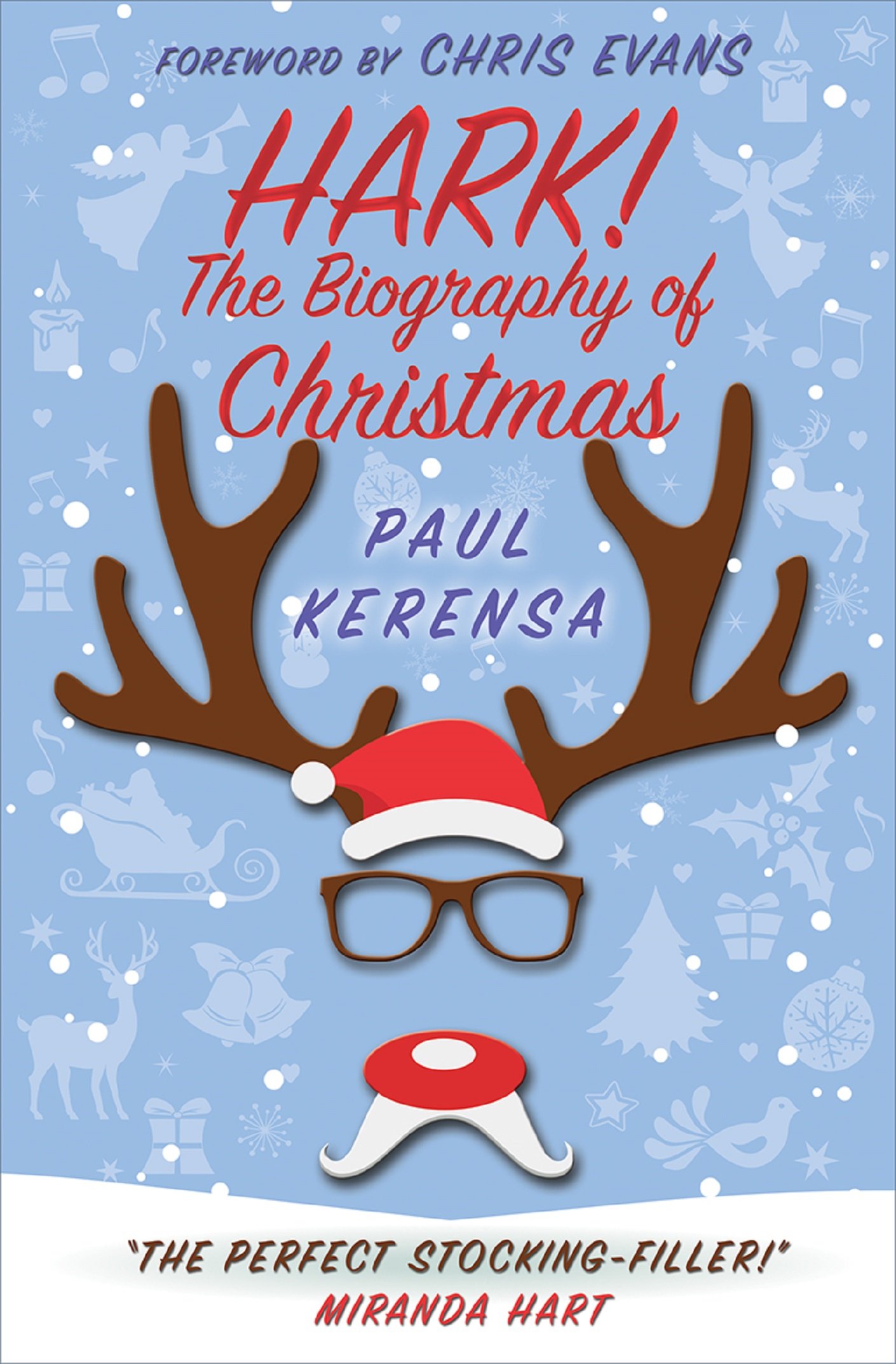
Hark! The Biography of Christmas – by Paul Kerensa

13 01 2026

I love a good Christmas book, and this was absolutely brilliant. It’s a full blown history of Christmas, from even before its origins, through to more recent traditions and I think literally everything in between! And yes, I know we’re well into January now, but I started this at the end of last year, so it’s ok!

Paul Kerensa is a comedy writer (he’s written on Miranda and Not Going Out), comic, media history enthusiast (he did a whole thing for 100 years of the BBC the other year and has really old copies of the Radio Times), and he’s a Christian (I think he sometimes does Pause for Thought on Radio 2). So he comes at this with all sorts of knowledge, but it feels really well researched on top of that, as well as being easy to read in his light-hearted style.

Here are some of the things I learnt

  • The immaculate conception refers to Mary’s birth, not Jesus’.
  • The 12 days of Christmas comes from a compromise between the Western church celebrating on 25th December, and the Eastern church on 6th January.
  • Good King Wenceslas was only made a king after he died – when he was alive he was a duke.
  • Christmas pies were rectangular (to look like a crib) meat pies. When Christmas was cancelled in the 1600s, people made them round and put mincemeat in to get around the ban.
  • Joy to the World was written about Jesus’ return, not His birth.
  • Knickers, Knickerbocker Glories, and the New York Knicks all trace their names back to a pseudonym used by Washington Irving who popularised the idea of St Nick in America.
  • Originally there were key differences between Father Christmas and Santa Claus:
    “Santa brings presents; Father Christmas just brings winter. The American version is child-friendly; the English version less so. Mr Claus wears a two-part suit and hat with white bobble; Mr Christmas wears a long one-piece habit with a hood. To this day the only major difference in appearance is in the subtlety of their headwear – hat versus hood is a handy way to spot an American Santa from an English Father Christmas.”
  • Dicken’s A Christmas Carol, Christmas Cards, and the carol “O Come All Ye Faithful” all appeared within a week of each other in December 1843.
  • Boxing day used to be the first weekday after Christmas. (And yes, that’s when we’d get a bank holiday now, but we don’t call that day Boxing day).
  • When a drawing of Victoria & Albert and their children admiring their 15ft Christmas tree was published in the USA, they removed Victoria’s crown and Albert’s moustache.
  • Dickens was in love with Queen Victoria:
    “On the royal wedding night at Windsor Castle in 1840, the already-married Dickens protested beneath the newlyweds’ bedroom window by rolling around in the mud.”
  • The original Miracle on 34th Street film was released in cinemas in May.
  • Star Wars did a Christmas special in 1978. It seems there’s a reason we haven’t heard about it….

I don’t normally enjoy history, but this was just fantastic, highly recommended if you are interested in where our modern day Christmas with all its quirks comes from.


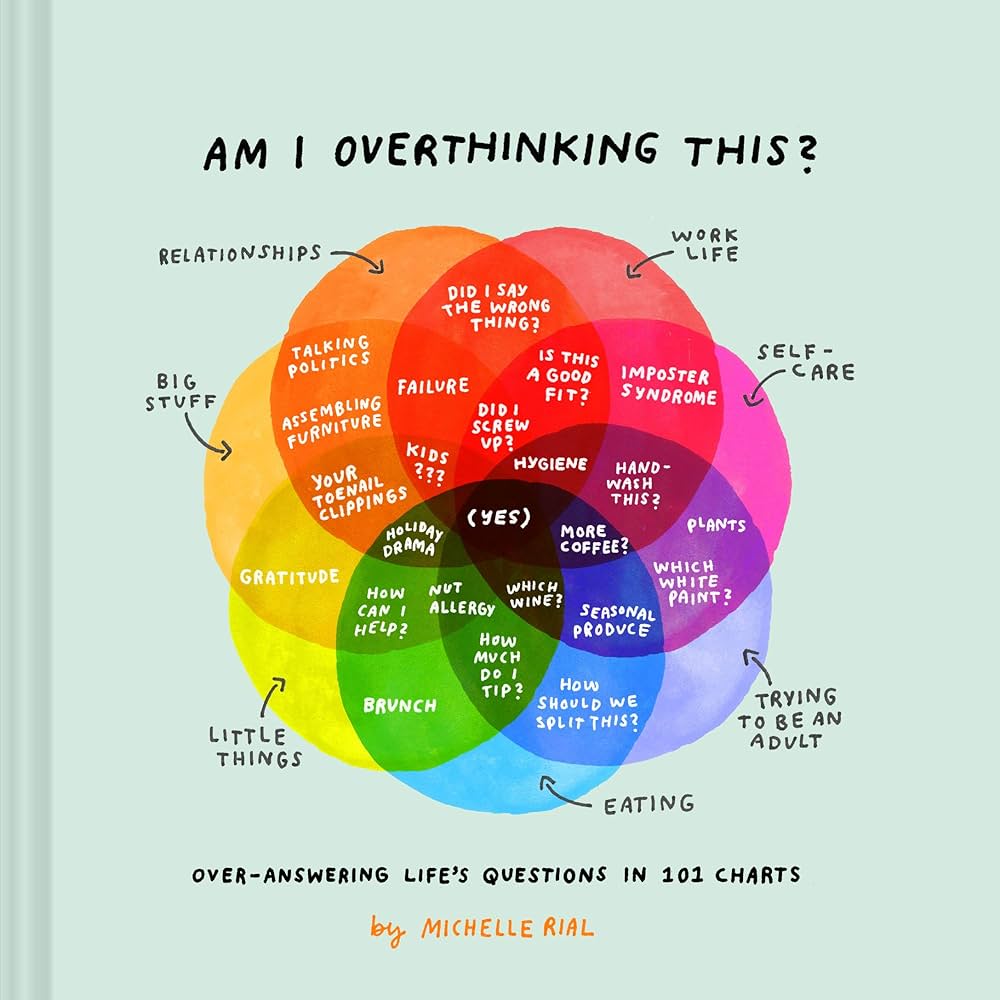
Am I Overthinking This? – by Michelle Rial

27 12 2025

Subtitled “Over-answering life’s questions in 101 charts”.

Very much a read in one sitting book, each page is a fun graph (yes, graphs can be fun!). Some were cleverer than others, but very enjoyable overall. To give you an idea, here are the names of some I liked:

  • Where are my Hair Ties?
  • How long should this dish soak?
  • Should we get ice cream?
  • Is brunch fiscally irresponsible?
  • Is it watermelon season? (by hemisphere)
  • Sill or sparkling?
  • Am I getting fired?
  • Should I lend you my books?
  • Do I have to hand-wash this?
  • Will parenthood change everything? (Hair washing frequency)
  • Will I ever use the math [sic] I learned in “Mean Girls”?
  • What if there really IS something wrong with me?


Humble Pi – by Matt Parker

26 12 2025

Subtitled, “A Comedy of Maths Errors”, this book takes you through common mistakes that have had huge impacts, but written in a light way that is easy and accessible to read.

From rounding errors to random numbers, from bridge building to medical treatment, all sorts of things are covered. It was so interesting!

Because it was a borrowed book (OK, I gave it to my Dad last Christmas, then borrowed it once he’d read it!), I didn’t turn down page corners, but still tried to make a note of some bits that were interesting or entertaining:

  • “Our human brains are simply not wired to be good at mathematics out of the box. […] All humans are stupid when it comes to learning formal mathematics.”
  • “A political committee is rarely a good solution to a mathematical problem.”
  • “If you’re reading this before Wednesday, 18 May 2033 it is still coming up on 2 billion seconds [since 1 January 1970]. What a party that will be.”
  • “We make things beyond what we understand, and we always have done. Steam engines worked before we had a theory of thermodynamics; vaccines were developed before we knew how the immune system works; aircraft continue to fly to this day, despite the many gaps in our understanding of aerodynamics.”
  • “Just because something walks like a number and quacks like a number does not mean it is a number. […] If you’re not sure if something is a number or not, my test is to imagine asking someone for half of it. If you asked for half the height of someone 180cm tall, they would say 90cm. Height is a number. Ask for half of someone’s phone number, and they will give you the first half of the digits. If the response is not to divide it but rather to split it, its’ not a number.”
  • “Age is systematically rounded down in many countries, a human age is zero for the first year of their life and increments to being one year old only after they have finished that whole period of their life. […] Which means that when you are thirty-nine you are not in your thirty-ninth year of life but your fortieth. If you count the day of your birth as a birthday (which is hard to argue against), then when you turn thirty-nine it is actually your fortieth birthday. True as that may be, in my experience, people don’t like it written in their birthday card.”
  • “There is nothing you can do to increase your chances of winning the lottery other than buy more tickets. Wait – I should specify: buy more tickets with different numbers.”
  • “In 2017 two researchers in Canada produced twelve sets of data which all had the same averages and standard deviations as a picture of a dinosaur. The ‘Datasaurus’.”
  • “You can still buy books of random numbers online. If you have not done so before, you must read the online reviews of books of random numbers. You’d think people would not have much to say about lists of random digits, but this vacuum brings out the creativity in people.”
  • “When I was a high-school maths teacher one of my favourite pieces of homework to set was to ask students to spend their evening flipping a coin one hundred times and recording the results. […] I could then take those lists and, by the end of the lesson, I had split them into two piles: those who actually did the homework […] and those who could not be bothered and just wrote out a long list of heads and tails off the top of their head.”
  • “We all make mistakes. Relentlessly. And that is nothing to be feared. […] Mathematicians aren’t people who find maths easy; they’re people who enjoy how hard it is.”


A Woman’s Place is in the Kitchen – by Sally Abé

20 11 2025

I’ve been a Great British Menu fan for years, and Sally has been a contestant on it a three times now. A friend who also watches the show got me her book for my birthday, and I’ve really enjoyed it.

You always hear that professional kitchens are very male heavy environments, but this book really painted a picture of what it’s like to be in one.

The book starts with her aged around 18 and with zero interest in food, going through to a hospitality degree, doing her placement at the Savoy, transferring to Claridge’s when the Savoy closes for refurbishment, and working her way up through various kitchens until she’s running her own. She’s good at explaining most things, to the point of too much repetition occasionally, but it means you nearly never feel alienated. There’s the occasional French term used but I just looked them up, and it’s not often!

There were a couple of times she made comments that did make me feel a bit lesser, for example “I considered dinner at Pizza Express an upmarket night out” – er, yup I still do! She also refers a couple of times to things that make her now smile at her naivety, but they are things that most readers would have no clue about, having not worked in a professional kitchen. A comment about “the most demanding customers – the ones who don’t dine out unless it’s a ‘special occasion'” also grated a bit…
This all said, they were few and far between, and as I said, most things she explained excellently.

I loved reading about how she wanted to run her kitchen as a place where people are just treated better.
– Where you don’t feel terrified of being told off for doing something wrong, but instead where someone else would step in and help.
– Where people don’t work 16 hour shifts (the idea that people do 16 hour shifts blew my mind!).
– Where some shifts are adjusted so that people who need to do the school run can still work in a kitchen.
– Where no one is allowed in the kitchen before the start time, where in her earlier roles, if you were less than an hour early, you were considered late!
– Where people help each other carry large pots instead of watching them struggle.
– Where someone can reduce their hours when pregnant rather than have to give up work entirely.
In short, where it’s not a “badge of honour” to have a horrendous work-life balance. Her aims are really fantastic, and she’s achieving them.

A lot of the book is sharing the experiences she had that led to her wanting to make these changes, so you hear some truly awful things, but more than anything I just found it interesting to read, to learn about a way of life SO different from mine!

Great British Menu only got the briefest of glancing mentions, which was a shame. Not that she was negative about it, she spoke of the business it brought (or would have brought, had it not been for Covid) to her restaurant. To be honest, very little of her life outside of kitchens was covered at all (maybe because so much of her life was IN kitchens!) so I guess maybe she deemed it outside the focus of the book.

She did however cover Covid, and what it was like for those working in hospitality – you can still hear a lot of bitterness in her voice about the decisions the government made, particularly early on, advising people not to eat in restaurants, but doing nothing to support those working in them, and later when things reopened, making them close at 10pm.

Definitely worth a read if you want to learn what it’s really like in the kitchens that make your (or at least, fancy people’s) food. And really encouraging in regards to how things are changing for the better in some kitchens, albeit still with a long way to go overall.


The Official History of Britain: Our story in numbers as told by the Office for National Statistics – by Boris Starling

19 04 2025

This book was so much fun – I know you don’t get that from the title, in fact, it sounds *incredibly* dry, but I assure you, it’s a fun read! All sorts of cynical comments and random tangents make it a really easy read, all while being really interesting! There were jokes at the expense of Tottenham fans and the population of East Anglia, as well as random bits of trivia and at times, just following his train of thought wherever it went!

The book is split into 5 sections:

  • The first three look at how things have changed over the last 200 years that regular censuses have been taken (Who we are, what we do, where we are)
  • The fourth is a focus on the 1921 census, which was just after the Spanish Flu, and given this was written in 2020 in the depths of the pandemic, a lot of comparisons are drawn.
  • And then finally an imaginative look ahead to what the 2121 census might look like, both in results, and how it’s achieved.

I really wanted to give this 5 stars, but there were just a few mistakes that meant I couldn’t do that: Categories mislabeled on a graph key, black and white diagrams with shades of grey too similar to decipher, and tables which didn’t show units, making them confusing to interpret. as well as one instance of talking about a value decreasing and then showing it increasing….. other than that, brilliant!

I’d be really interested in reading a re-issue of this now that we’re out of COVID (for the most part), with a bonus chapter or two looking at how it affected things as a lot was made of what effect it might have, but at the time of writing, it was too soon to tell.

As it is, it was bookended with this quote from Lord Kelvin: “If you cannot measure it, you cannot improve it”


How to Pray – by Pete Greig

20 03 2025

A couple of years ago we did The Prayer Course in our homegroups at church, and it was excellent. Soon afterwards, I picked up the book that tied in with it, and FINALLY I’ve got around to reading it!

It’s a really helpful book, looking at different types of prayer at a really accessible level, and with plenty of anecdotes and examples to help apply what’s being said. But bookending all that, he says that it’s most important to just: “Keep it simple, keep it real, keep it up”. I was glad he did that, because I sometimes think we overcomplicate prayer with splitting it up into all these different types and “how to” do each of them – we learn as a kid is that prayer is just talking with God, building a relationship with Him, so I was pleased he brought it back to this.

Prayer is definitely something I’m not great at, but this book didn’t make me feel bad about that, and was written in a way that didn’t feel too clever, fancy or intimidating – it was encouraging! It also comes with a load of recommended further reading and links to an online toolshed of resources, which I’m looking forward to delving into somewhen.

He shared the story of King George VI calling the country to a day of prayer before Dunkirk, which I had no idea about, and gave a great analogy using the boys who were rescued from the cave in Thailand, how there was a long wait for them between being found and being rescued, and how we can liken that to the now and not yet of our Salvation through Jesus.

Definitely a book I’ll be back to dip in and out of.


The Human Body in Minutes – by Tom Jackson

9 12 2024

A marked improvement on the world history version, this was more science-y which is my cup of tea, and less assumed knowledge which is where the other one fell down for me. It still had a few typos, which makes sense given it’s the same series of books, but a different author at least improved the other issues.

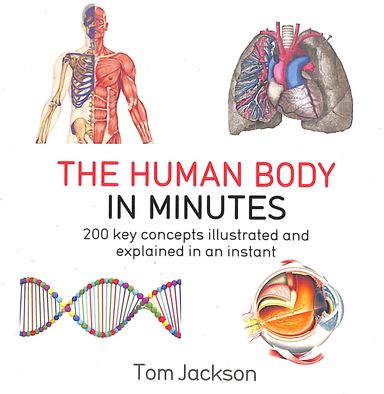
It’s a page per thing, and covers all sorts of levels too, so right down to individual types of cell, up to whole systems across the body, and at the end, cloning, and death – so most things you’ll want to know about will be in here, it’s all just brief, which is what I wanted. Most double page spreads are a page with a couple of paragraphs on the left, and a diagram on the right. Good for an overview.


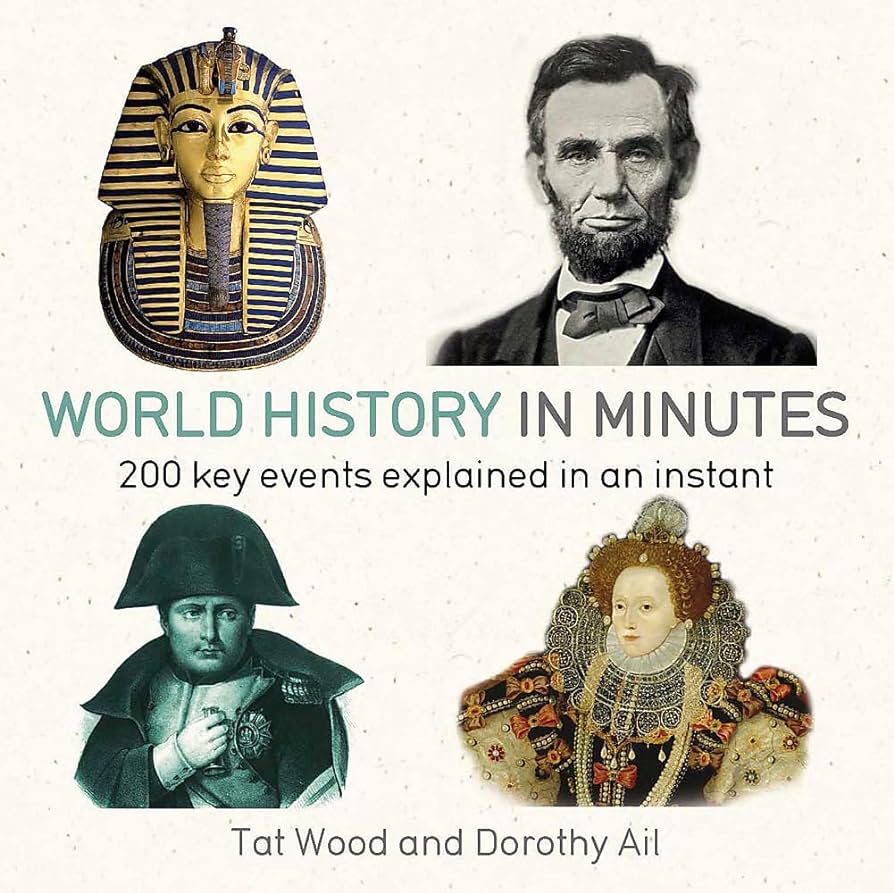
World History in Minutes – by Tat Wood and Dorothy Ail

6 12 2023

I picked this up as a way to give myself a quick overview of lots of things I didn’t know. I didn’t like history at school (with a couple of exceptions for the Tudors and Victorians), but thought it would be good to give myself a basic education.

I don’t think this book was the right choice. A lot of the pages seemed to have a load of assumed knowledge on people/places/scenarios, so I didn’t have a clue what they were on about, there wasn’t enough explanation. It also had a large number of typos that a basic spell check would have picked up on, which made me question the quality of what I was reading too. Most pages had an illustration, be it photo, diagram, painting, but they were all in black and white, so when it was a map with a key, it was very hard to distinguish between various shades of grey.

It starts with pre-history and goes right through to the 2008 credit crunch. I particularly struggled with the early stuff, cos I found that I just didn’t care enough, which meant I had a negative attitude through most of the book, and combined with the quality issues mentioned above, I’m just very relieved to have got to the end and ticked it off – it took me a month! Not a book I’ll be keeping.


The Four Loves – by C.S. Lewis

6 05 2023

At only 170 pages, I thought I might get through this fairly quickly, even if it is non-fiction. I was wrong, it took me nearly two months! I think really it was just a bit too clever for me.

Lewis discusses the difference between need-pleasures and appreciative pleasures, between need-love and gift-love, before getting to the main content of the book – the four types of love: Affection (storge), Friendship (philia), Eros (romantic) and Charity (agape).

From the chapter on friendship: “Friendship is unnecessary, like philosophy, like art, like the universe itself (for God did not need to create). It has no survival value; rather, it is one of those things which give value to survival.”

Eros he says is about the Beloved, not necessarily the sexual connotation we tend to give the word – he separates this part out and names it “Venus”. (They can come together, but there can also be “Venus, uncontaminated by Eros”). All this makes the following quote less weird: “Affection is taken as the image when God is represented as our Father; Eros, when Christ is represented as the Bridegroom of the Church.”

The book doesn’t have the best attitude towards women, at one point considering them unable to join men’s conversations as they would need the discussion explained to them. But I think we just have to put this down to the time the book was written, and move on.

There was an interesting section at the end about whether we’ll recognised loved ones in heaven, but I genuinely couldn’t tell you what his stance was on it. Probably a book for people more studious than myself – I’m very much ready to dive back into some chick-lit now.


Black and British: A short, essential history – by David Olusoga

28 09 2022

There is a version of this book which is over 600 pages, and goes into a lot more detail, but as someone who struggled with history at school and is very slow to read non fiction I would never consider even trying to read it. So I was delighted to find that there was a children’s version of the book that would cover it more at my level – the words are more spaced out too!

It covers black British history as far back as the Romans, then jumping forward to the Tudors and working through from there to the 20th Century. It’s a great resource covering so much that we weren’t taught in school, or in other ways we learn about our country.

One of the things that stood out to me the most was that the celebrated abolition of the slave trade in 1807 was not the end of slavery; it was only the trade that became illegal at that point, but it can tend to be talked about it like everything was done at that point.

The book is also full of illustrations and images to help follow what’s going on. It’s a really accessible book, and so if like me, history isn’t your thing, this is a non-scary way of learning a bit more. I think I’ll need to read it a couple more times over the years for a refresh, but it’s not difficult to read!