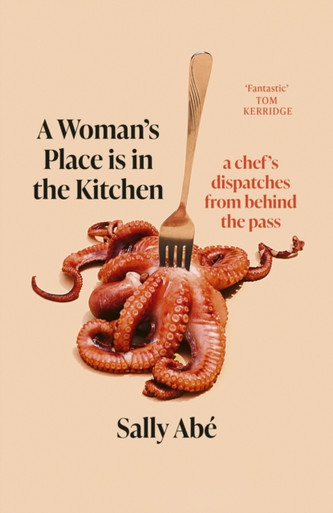
A Woman’s Place is in the Kitchen – by Sally Abé

20 11 2025

I’ve been a Great British Menu fan for years, and Sally has been a contestant on it a three times now. A friend who also watches the show got me her book for my birthday, and I’ve really enjoyed it.

You always hear that professional kitchens are very male heavy environments, but this book really painted a picture of what it’s like to be in one.

The book starts with her aged around 18 and with zero interest in food, going through to a hospitality degree, doing her placement at the Savoy, transferring to Claridge’s when the Savoy closes for refurbishment, and working her way up through various kitchens until she’s running her own. She’s good at explaining most things, to the point of too much repetition occasionally, but it means you nearly never feel alienated. There’s the occasional French term used but I just looked them up, and it’s not often!

There were a couple of times she made comments that did make me feel a bit lesser, for example “I considered dinner at Pizza Express an upmarket night out” – er, yup I still do! She also refers a couple of times to things that make her now smile at her naivety, but they are things that most readers would have no clue about, having not worked in a professional kitchen. A comment about “the most demanding customers – the ones who don’t dine out unless it’s a ‘special occasion'” also grated a bit…
This all said, they were few and far between, and as I said, most things she explained excellently.

I loved reading about how she wanted to run her kitchen as a place where people are just treated better.
– Where you don’t feel terrified of being told off for doing something wrong, but instead where someone else would step in and help.
– Where people don’t work 16 hour shifts (the idea that people do 16 hour shifts blew my mind!).
– Where some shifts are adjusted so that people who need to do the school run can still work in a kitchen.
– Where no one is allowed in the kitchen before the start time, where in her earlier roles, if you were less than an hour early, you were considered late!
– Where people help each other carry large pots instead of watching them struggle.
– Where someone can reduce their hours when pregnant rather than have to give up work entirely.
In short, where it’s not a “badge of honour” to have a horrendous work-life balance. Her aims are really fantastic, and she’s achieving them.

A lot of the book is sharing the experiences she had that led to her wanting to make these changes, so you hear some truly awful things, but more than anything I just found it interesting to read, to learn about a way of life SO different from mine!

Great British Menu only got the briefest of glancing mentions, which was a shame. Not that she was negative about it, she spoke of the business it brought (or would have brought, had it not been for Covid) to her restaurant. To be honest, very little of her life outside of kitchens was covered at all (maybe because so much of her life was IN kitchens!) so I guess maybe she deemed it outside the focus of the book.

She did however cover Covid, and what it was like for those working in hospitality – you can still hear a lot of bitterness in her voice about the decisions the government made, particularly early on, advising people not to eat in restaurants, but doing nothing to support those working in them, and later when things reopened, making them close at 10pm.

Definitely worth a read if you want to learn what it’s really like in the kitchens that make your (or at least, fancy people’s) food. And really encouraging in regards to how things are changing for the better in some kitchens, albeit still with a long way to go overall.
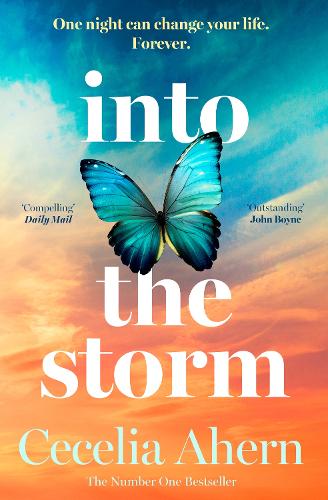
Into the Storm – by Cecelia Ahern

2 11 2025

My annual Cecelia Ahern read! I’ve found she tends to write two kinds of books, all fiction, but either with or without an element of magical realism, so whenever I start a new one, it’s interesting to see which it will be! In this case, it’s just general fiction, but a story I really got invested in.

Enya is a GP, and driving home from a call out during awful weather on the shortest day of the year she comes across the scene of an accident, a teenager in the road, and a man who says he just drove up and found him there. She obviously stops to help, but where she’d been struggling mentally with approaching the age her mother died, and following this trauma, she decides it’s time for a big change.

The story continues both with her adapting to her new life, while also dealing with the fall out from that night, and gradually finding out more about what happened, so that by the end of the book, we have the full story.

The book is broken into different times of the astronomical year, her mother had an interest in pagan ideas, and there’s a rag tree involved in the story – I was a bit concerned at one point about how pagan-y it might get, but it really wasn’t much at all in the end.

I enjoyed seeing how Enya’s relationships with her son, her sister, and others she meets along the way change and develop through the book, and particularly with the woman who lives above her surgery who is going through her own struggles.


Jane Eyre – by Charlotte Brontë

19 10 2025

For my annual read of a classic, I went for Jane Eyre. The last six years I’ve read the main six Austens, so thought it was time for my first Brontë (Charlotte). I’d watched the Ruth Wilson adaptation before, and had a rewatch for a refresher before I got going.

In my head, I didn’t think it wouldn’t be that much different to an Austen, the books are within a few decades of each other, but it’s definitely darker and grittier, and less about society. Another massive difference is that it’s told in the first person, from Jane’s perspective, and so is much more emotive and engaging in its narrative.

The book follows Jane’s story from orphaned child living with family that don’t want her, through boarding school, to working as a governess in a house with a secret, and the fall out from that.

I was grateful that my edition had notes in the back, they were helpful to explain a few terms we no longer use, as well as when the girl she was governess for chattered away in French, it kindly gave a translation! One thing I found utterly bizarre though, is that any large place name was anonymised! So you’d get references to -shire, etc. I googled and this seems to be a thing from the time, as if the fact it’s been anonymised makes it sound like they’re real people, but it took some getting used to. Also, the number of times that a door or a box or anything was “unclosed” instead of opened – I wonder when that changed! I really enjoyed when at one point she said “thither I bent my steps” – so similar to the line in ‘O Come All Ye Faithful’ which has always tickled me!

There is talk throughout the book of how Jane is not attractive, both from her and others saying it about her, and the same is said of Mr Rochester, they say it to each other, it’s really quite refreshing, and made the characters feel a lot more relateable. I also love when her refers to her as Janet, I never thought of it as a pet name for Jane, but maybe it is?!

As per usual, a few bits that made me turn down page corners:

  • “Children can feel, but they cannot analyse their feelings; and if the analysis is partially effected in thought, they know not how to express the result of the process in words.”
  • “It is not violence that best overcomes hate – nor vengeance that most certainly heals injury.”
  • “We know that God is everywhere; but certainly we feel His presence most when His works are on the grandest scale spread before us; and it is in the unclouded night-sky, where His worlds wheel their silent course, that we read clearest His infinitude, His omnipotence, His omnipresence.”
  • “I would always rather be happy than dignified.”
  • “As she grew up, a sound English education corrected in a great measure her French defects.”

In summary: Reader, I loved it.


A Beginner’s Guide to Breaking and Entering – by Andrew Hunter Murray

23 08 2025

Very different from his first novel (and I haven’t read his second!) – the premise of this book sounded so much fun: a guy who house sits for rich people, except they don’t know it. You might call him a squatter, he calls himself an interloper. He stays in wealthy people’s second homes when he knows they’re away, and leaves no trace – fun, yes?!

I thought the whole book was going to be based around this, and in a way it is, but really it’s more that that’s the set up for the story, which is sort of a murder mystery while on the run as suspects. I don’t think that gives too much away as it’s on the back of the book! It’s even narrated from the information suite in his prison…

I really enjoyed it, there’s a good amount of fun among the drama, and a few niche British references that would make Richard Osman proud! (eg: “I wonder fleetingly whether the police and the Bake Off crew get their marquees from the same firm.”).

There was also a wonderful anecdote about Ann Hicks, who sold apples in Hyde Park in the 1830s, built a tiny shack to sell from, gradually added to it, windows, doors, extended upwards, until she had a two storey house and a shop front in the middle of Hyde Park. Due to patchy records, she ended up being paid a weekly allowance by the Duke of Wellington to leave so they could build a bit crystal palace – a brilliant story, and clearly Hunter Murray’s QI-elf-ness hasn’t completely left him!

I think what I’d really like is a prequel, maybe a series of short stories of his escapades before this whole incident kicked off, of life as an interloper. It’s fun in this book to learn of his series of rules of interloping, but there must be stories from where some of them came from that could be a good premise.

A couple of excellent lines:

  • “I have a faint memory that impersonating a police officer is a crime that comes with an especially long sentence. The police don’t like it when you do impressions of them. (I find this particularly unfair, because apparently they’re allowed to do impressions of normal people and that’s just ‘undercover work’.)”
  • “You may have noticed that I’ve also changed Qumar’s name, from a country you will be familiar with to a fake country they use in The West Wing when they needed somewhere for President Bartlet to bomb. If Aaron Sorkin objects to me lifting the name, he can sue me. I’m literally writing this from prison and have no fear of copyright infringement.”
  • “I do look up the price of ferry tickets, then a few property portals to see how much the average mountain chalet sets you back these days (a lot, it turns out; these ski people must be made of money and still they choose to go somewhere cold? Insane)”


The Greatest Story Ever Told – by Bear Grylls

9 08 2025

The premise of this book seems to be to tell the story of Jesus in one flowing narrative, so combining all four Gospels, and told from the viewpoint of five eye witnesses to His life: Mary (His mother), Thomas, Simon, John and Mary Magdalene.

I think I went into this with maybe a slightly more cynical outlook, looking for faults in the story as it were, as someone very familiar with the story. But for someone investigating Christianity but wanting something less intimidating than the Bible, I think this would be a great starting point.

I’m not sure there was much difference between the narratives other than His mother Mary’s, as that is necessary to tell the beginning of the story, from her becoming pregnant, through raising Him, to the wedding in Cana, at which point Thomas takes over the narration, but there didn’t seem to a reason that Simon couldn’t have done the rest of the book, I guess it was maybe broken down so as not to give one disciple huge prominence, but I didn’t feel much of a shift in style when the narrators switched.

Generally it’s very close to the Bible – every word spoken by Jesus specifically, is taken directly from scripture, and there isn’t much artistic licence used, as I guess the authenticity is important for a non Christian readership. But occasionally a weird thing was thrown in, like Jesus working for Joseph of Arimathea before He started His ministry…. that seemed an odd choice.

There was also the parable of the lost son, where the ending was just missed, where the older brother complains at the celebrations. To be honest, there’s a lot of His teaching that isn’t in there, I guess cos otherwise it’d have to be a much longer book. What is included of that, is often put in as a memory of “I remember when He told us…”, so definitely not all in order either, but it’s clear when it’s intentionally not. There are many miracles included though, my memory isn’t good enough to say if all!

A couple of times he added a tone to someone’s voice that I wasn’t sure how realistic it was, especially when he describes Pilate as sarcastic when he refer’s to Jesus as King of the Jews, but I would argue that there is nothing in the Bible to imply he didn’t mean that – quite the opposite in fact:

The chief priests of the Jews protested to Pilate, “Do not write ‘The King of the Jews,’ but that this man claimed to be king of the Jews.”
Pilate answered, “What I have written, I have written.”

– John 19 vv 21-22

Overall it was good; it tells the story in a very readable way. I think the above probably comes across as negative, because I am, by nature, a hole picker (just ask anyone I work with!), but don’t let that put you off.


The Court Jester – by Mansour Bahrami

24 07 2025

Mansour Bahrami has been my favourite tennis player for a long time. After growing up in Iran, and playing tennis with a broomstick handle in an empty swimming pool, he got his chance to play properly, but then just as top flight tennis was becoming an option, there was a revolution in the country. Who knows what he might have achieved if that wasn’t the case.

But as it is, he loves the sport, performing for a crowd, and would intentionally lose games to help make a match go on for longer! He’s most known for his tricks, mucking about, and general sense of fun.

He plays in the invitational doubles at Wimbledon each year (normally available on iPlayer in the second week of the tournament), and I’ve even watched him play at the Royal Albert Hall in 2013 (photo at the bottom where I queued up afterwards to meet him!).

He wrote the book in 2006, so it’s covering the first 50 years of his life, and it’s so interesting. There’s so much sadness and hardship that he’s been through, and yet, what he truly loves to do is entertain, it’s a joy. He’s now 69, and still as full of beans as he’s ever been.

I’ve found a video montage of some of his Wimbledon highlights from a couple of years ago, and listed many of the things I love about him! Please do enjoy

  • When he asks the umpire for a “mister”
  • When he serves with six balls in his hand
  • When he indicates to his opponent where is in and where is out after they miss, or that it needs to go over the net
  • When he catches a ball in his pocket
  • When he slowly creeps up to the net while waiting for his opponent to serve as if they can’t see him
  • When there’s a ball in his hand when the other team is serving, just incase
  • When he plays from both sides of the net
  • When he lets someone else (ball kid/someone from the crowd) play for him
  • When he pauses a point to pose for photos mid match
  • When he stands still and has the other players hit to exactly where he is
  • When he spins after each hit of the ball
  • When he encourages the other team with a “you can do it!”
  • When he stands right up at the net waiting for service, and then lifts it as the ball comes
  • When he takes the mick out of those who take forever to serve
  • How much he clearly loves every minute of it


The Sunshine Kid – by Harry Baker

15 07 2025

The third (and final for now) in my little run of Harry Baker’s poetry – though actually his first chronologically, written while he was still a student, so that made me feel old! I was pre-ordering his next book which comes out next year, and added this on to get free delivery and complete my collection!

From time to time, I thought the feel of this book was a bit different to the others, some of the poems felt a lot longer, which I sometimes struggled to focus the whole way through, but that’s on me. That said, there were still plenty I liked, including “59” (a love poem about prime numbers), “The scientist and the bumblebee” (looking at believing in impossible things, since scientists have apparently proved that bumblebees shouldn’t be able to fly) “Monopoly” (to the tune of “That’s what makes you beautiful” by One Direction), and finally “Haiku deathmatch”, which was actually 59 haikus broken into 4 sets throughout the book. I say haikus, I would argue that the 5-7-5 structure was lost pretty quickly, but they were so fun, and punny, that I forgave it!


Four – by Veronica Roth

14 07 2025

So while the Divergent books were technically a trilogy, the author wrote a fourth book, giving a bit of backstory to the male lead (called Four), since the first two books of the trilogy were told purely from Tris’ perspective. It’s told as four short stories, and three mini chapters, though the short stories flow fairly well chronologically anyway. That said, I wouldn’t suggest reading this if you haven’t read the trilogy first, as there’s definitely some assumed knowledge! (And don’t think the films will be enough, I watched them recently and the plot seemed to veer right away from the books!)

I enjoyed the stories that were set before the trilogy starts, but once it got to those that overlap, I just felt like I was reading something I’d already read, I didn’t feel like his perspective added a tonne to it. If you’ve read the trilogy it’s worth a quick read through, but I wouldn’t rave about it.

One line though that I thought was worth sharing: “Dead people can be our heroes because they can’t disappoint us later; they only improve over time, as we forget more and more about them.”


Unashamed – by Harry Baker

7 07 2025

Less than a month after reading his third book, I’ve now read his second (also, his first is on order and fourth is on pre-order!). I was privileged to see Harry perform live last week, and so got this book then! The poems take on another dimension when performed, but it’s still great to be able to have copies of them to be able to pick up and read any time.

This time the maths and German themes felt even more prominent, as well as chat about marathons and his mum. There’s a poem that runs through the book with a stanza between each other poem, taking you through the maths of a marathon!

Again, it’s crazy hard to narrow it down to a few favourites, but I loved “Falafellöffel” (translation: falafel spoon), “Knees” (how great his are), “Toilet Seat” (the joy of a new one), “An A-Z of Time and Space” (what it says on the tin) and “Christmas Through the Ages” (a look back on the first 24 Christmasses of his life)! Even his chat between the poems, introducing them was really fun and warm too, and gave you a good feel for what he’s probably like.

This book also introduced me to the concept of a Dougie Day (and the excellent young man who inspired it), but I was devastated to find I’d missed mine!


We Solve Murders – by Richard Osman

5 07 2025

I really enjoy the Thursday Murder Club series by Richard Osman, so when he wrote a book that wasn’t in that series, I was interested to see if it was as good – and I do think it was!

So the basic premise is that Amy is a close protection officer, currently looking after a world famous author Rosie on her private island, and Amy’s father-in-law Steve is a retired cop, living in the New Forest. But then various people who are trying to get other people killed get involved, there are influencers, money smugglers, all sorts of things.

And I think this is the only reason I didn’t give it 5 stars (I would have given it 4.5 if that was an option on goodreads) – there are a lot of fringe/secondary characters, and I don’t know if it was that they weren’t given enough intro to bed them into my brain, or if there were just one or two too many of them, but I did have to keep trying to remember who some of them were during the first half, and one of them even later on I was still struggling to place. But I don’t want to be too negative, that really was the only negative for me.

I think Richard Osman’s greatest strength is his characters, and their little eccentricities which really endear them to you. I particularly loved Steve and Rosie this time around, I related to Steve a lot in his desire to potter about somewhere he knows – and Rosie was just so extreme and extravagant in so many ways! The contrast between them was a lot of fun.

What was also enjoyable for me were the bits set in the New Forest, I grew up just outside the national park, and so it was fun to hear references to different places I knew!

As I often do, here are some of my favourite one liners

  • “Jeff looks over at Tony, ‘No offence.’
    ‘I never take offence,’ says Tony. ‘Saved me a lot of time over the years.'”
  • “Trouble [the cat] never stopped to ask [what flavour his dinner was]; he just loved food that he hadn’t had to catch or scavenge for himself.”
  • “What unfortunate timing. If she’d known she was going to die this morning, she would have ordered the pancakes.”
  • “‘And how did she score on your psychopath test?’
    ‘Ninety-six, same as me. That’s why she’s Head of HR'”