Dream a little Christmas Dream – by Giovanna Fletcher

2 01 2016

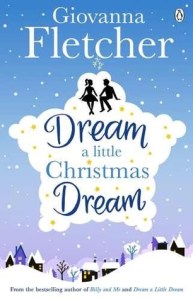
Giovanna Fletcher seems to be another author whose books I’ve gotten into the habit of reading, so when she brought out a little Christmas Novella like last year, based on the novel she had published this summer, I thought, why not?!

I was so keen to finish my last book that yes, I have read this one in January, but it’s only 85 pages and I managed it in about 3 sittings.

It’s warm, fuzzy, and predictable – I had the ending pegged from only a few pages in, but that doesn’t mean it didn’t still give me goosebumps at the end, very feel good, pretty much exactly what you’d expect from a mini Christmas chick-lit read. Delightful.

dream a little christmas dream


Look who’s back – by Timur Vermes

31 12 2015

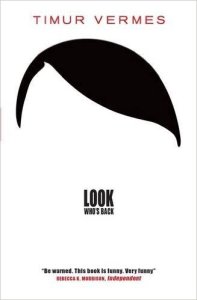
We’re all taught not to judge a book by it’s cover, but I believe it’s ok to pick one up because of its cover to see if the blurb is any good. (In fact, I think I did a similar thing with Paradoxology!) I scrolled past this book on Amazon and took a double take at the distinctive cover, read the blurb and was totally won over by the concept – a complete impulse buy.

The best way for me to tell you what this book is about is to put the blurb below, because it tells you exactly what it’s about!

Berlin, Summer 2011. Adolf Hitler wakes up on a patch of open ground, alive and well. Things have changed – no Eva Braun, no Nazi party, no war. Hitler barely recognises his beloved Fatherland, filled with immigrants and run by a woman.

People certainly recognise him, albeit as a flawless impersonator who refuses to break character. The unthinkable, the inevitable happens, and the ranting Hitler goes viral, becomes a YouTube star, gets his own T.V. show, and people begin to listen. But the Führer has another programme with even greater ambition – to set the country he finds a shambles back to rights.

There really isn’t that much else to say about it, it does exactly what it says on the tin, and things enfold pretty much as you would expect 🙂 There are some great one liners, and some really good observations on modern day living, as if it were just anyone who had jumped forward 70 years or so!

If you’re offended by the concept, probably don’t read it, but if it intrigues you, then definitely do!

look who's back


Emma – by Alexander McCall Smith

25 11 2015

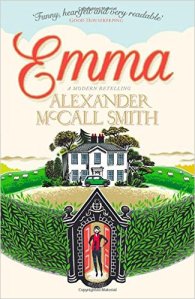
I was excited to read this entry in the Austen Project, and see how McCall Smith had managed to modernise this story, particularly as it’s been done successfully before in the 90s film, Clueless.

Sadly, I don’t think this book did as good a job. Yes the English is modernised so it’s easy to read, and Emma now drives a mini, but she still lives in a 14 bedroom house and has a governess – even if they do comment how unusual it is for this day and age, why do it?!

I quite liked that Emma had been to Bath Uni, as that’s where I went, but it sounds more like she went to Bath Spa as she did a “decorative arts” course!

It was a fun book, the characters are generally exactly as they should be, but I just don’t think the modern day aspect came across which was a shame. If you were just reading it as a book with no blurb and no pre-conceptions then of course it was great!

I’m looking forward to seeing who they’re going to get to write the next one in this series now, I believe Pride and Prejudice is due next!

emma


Paradoxology – by Krish Kandiah

3 11 2015

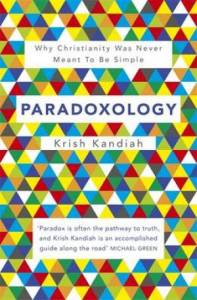
If you find someone who claims they didn’t initially pick up this book because of its cover, I bet they’re lying! The author even ended up talking to the public from a matching sofa! Yes, I did pick this book up because it was a brightly coloured, geometric pattern, but normally I’d have a quick look and put it down again. Instead, I read the back and thought, gosh this sounds interesting. And I wasn’t wrong.

I take forever to read non-fiction, so the fact this took three months isn’t a bad thing. If you saw the number of page corners I’ve folded down, that speaks for itself. For each chapter, the book takes a character (or occasionally a book) and the paradox tied in with it to look at, so the book could be dipped in and out of, chapter by chapter if you wanted to. The chapters are as follows:

  • Introduction
  • Abraham – The God who needs nothing but asks for everything
  • Moses – The God who is far away, so close
  • Joshua – The God who is terribly compassionate
  • Job – The God who is actively inactive
  • Hosea – The God who is faithful to the unfaithful
  • Habakkuk – The God who is consistently unpredictable
  • Jonah – The God who is indiscriminately selective
  • Esther – The God who speaks silently
  • Interlude at the border
  • Jesus – The God who is divinely human
  • Judas – The God who determines our free will
  • The Cross – The God who wins as He loses
  • Romans – The God who is effectively ineffective
  • Corinthians – The God who fails to disappoint
  • Epilogue – Living with Paradox

He highlights in his introduction how these aren’t questions every asks, but that a lot of people avoid asking, for fear of shaking our faith. At one point I was going to put in here the bit from each page that I folded down, but that would now be a tad excessive. But I’ll share two or three – Kandiah’s text is littered with citations, quotes and footnotes, so I’ve given credit to others where it’s due:

“Cheap grace is the preaching of forgiveness without requiring repentence, baptism without church discipline, Communion without confessions.” – Dietrich Bonhoeffer

“It was no accident, either, that God appeared to Moses as a flame. The movement of a flame and its bright colours attract us, and yet the heat of the flame pushes us away.”

“There is no such thing as atheism. There is no such thing as not worshipping. Everybody worships. The only choice we get is what to worship.” – D F Wallace

There’s a lovely story from a Royal Film Premiere when he didn’t quite get to meet the Queen, an excellent look at the hotel with infinite rooms problem, and wave particle duality and Schrodingers Equation. He also introduces us to some paintings and the significance in what they show – I felt quite well educated after reading this!

The only critique I’d give this book is that some chapters could have been helped by starting with either an overview of the story of the character we were looking at, the relevant bible passage, or at least a reference to the correct bible passage. I have to confess, when we jumped into Habakkuk, I didn’t have a whole load of background knowledge to go by!

paradoxology


Dream a little Dream – by Giovanna Fletcher

23 08 2015

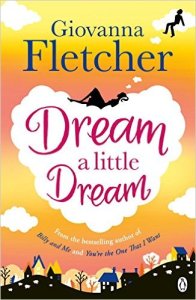
It’s just over a year since I read Giovanna Fletcher‘s first novel, and now here’s her third! As expected, it’s pretty much cosy, comfy chick-lit, with a bit of drama along the way. Which really, is all you want in a summer read! (I actually started a book called Paradoxology before this one, but as I was going on holiday, thought it might be worth switching to something lighter! I’ve now returned to the first book…!)

A girl starts to repeatedly dream about a guy she barely knew several years ago, and in her dream, slightly fall in love. So of course he then turns up out of the blue in real life, causing some very confused feelings!

To be honest, there’s not a lot to say about this book, I read it in two weeks which for me is pretty quick – partly because it’s an easy read, and partly because I wanted to know what happened! Predictable as it was, you may have guessed what was going to happen, but you always want to know how!

Definitely a good holiday read!

The author has also just announced that, like she did with Billy and Me, she’ll be releasing a Christmas Novella, based around the same characters. Sadly this time it sounds like it might be ebook only, whereas last time Waterstones sold Christmas with Billy and Me in paperback! To be honest, this means I may well not read it!

dream a little dream


Us – by David Nicholls

1 08 2015

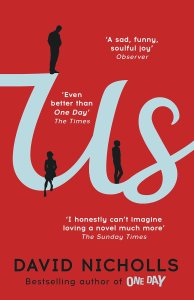
Having loved the idea and the story behind ‘One Day’ by David Nicholls, both book and film, the fact that The Times called this “Even better than One Day” meant I had to give it a go!

Early on in the book we hear Connie (an artist) tell Douglas (a scientist, and the narrator of the book) she thinks she wants to leave him when their son Albie goes to University in the autumn. From then on we follow two stories in parallel: How they met and reached that point, and from that point, how Douglas attempts to save their marriage and the respect of his son during a “Grand Tour” of Europe, seeing all the art galleries, that they already had planned.

The story from that point on mainly revolves around the difficult relationship between Douglas and Albie – Albie being a fairly hipster teenager, and his dad being a slightly awkward, boring and formal scientist. Made all the more difficult by the closeness that does exist between Connie and Albie. I won’t go much further with that as I don’t want to give too much away, but it’s told so well.

I found myself folding down corners of pages as I went when there was a sentence or phrase that I thought was particularly interesting or thought-provoking. I’ve checked them for spoilers and shared a few below:

  • “In short, my son makes me feel like his step-father.”
  • “I’ve got nothing against his dreams as long as they’re attainable.”, “But if they’re attainable then they’re not dreams!”
  • “It was a good joke, though perhaps not enough in itself to save our marriage.”
  • “Was it the happiest day of our lives? Probably not, if only because the truly happy days tend not to involve so much organisation, are rarely so public or so expensive.”
  • “The tourist’s paradox: how to find somewhere that’s free of people exactly like us.”
  • “But the trouble with living in the moment is that the moment passes.”
  • “The great virtue of defeat, once accepted, is that it at least allows one to rest. Hope had kept me awake for too long.”

Knowing that Nicholls doesn’t always write happy endings, I was fairly apprehensive for the last third of the book, but obviously I won’t tell you what happened!

Us


Mary Poppins – by P L Travers

21 07 2015

Most people have seen the film Mary Poppins, but not many have read the book. However, last year I saw the film Saving Mr Banks, which is all about when the story was sold to Disney to be made into a film, told alongside Travers’ childhood story, and it stirred my interest in reading the original children’s book. (Trailers for both films can be found at the bottom of this post)

mary poppins

I was surprised at how different it was; I didn’t like the character of Mary Poppins at all. But before I get into that, some other major differences between the book and the film.

  • There are four Banks children in the book: Jane & Michael who we know from the film, but also twin babies John and Barbara.
  • Bert (the chimney sweep) barely gets a look in. He’s in the first chapter, and gets a mention in the last, but doesn’t appear at all in between.
  • Mr Banks doesn’t have any trouble with his job at the bank at all (I wonder if this comes up in a later book?)

If I had to describe Ms Poppins in 5 words from this book I would go with: Vain, Stern, Conceited, Serious, Grumpy. I know in the film she is quite stern and serious, but at least she smiles and has fun sometimes. I think she was Disneyfied for the film; in the book she doesn’t smile once. She also has a complete fascination with how she looks – I quote from the penultimate chapter while they are out Christmas shopping:

“May we look at the windows first?” said Michael hopping excitedly on one leg.
“I don’t mind” said Mary Poppins with surprising mildness. Not that Jane and Michael were really very surprised, for they knew that the thing Mary Poppins liked doing best of all was lookinh in shop windows. They knew, too, that while they saw toys and books and holly-boughs and plum cakes Mary Poppins saw nothing but herself reflected there.
[…]
“Just look at you!” said Marry Poppins to herself, particularly noticing how nice her new gloves with the fur tops looked. They were the first pair she had ever had, and she thought she would never grow tired of looking at them in the shop windows with her hands inside them. And having examined the reflection of the gloves she went carefully over her whole person – coat, hat, scarf and shows, with herself inside – and she thought that, on the whole, she had never seen anybody looking quite so smart and distinguished.

So all in all I did not like this woman!

The book is essentially a set of short stories. The first chapter covers Mary Poppins’ arrival, and the final chapter, her departure, but each of the others is its own little adventure or story, so I guess in the childrens’ book world, you could read a chapter a night as a bedtime story. I’m aware this is me as an adult reading a childrens’ book that was not designed for me!

One thing I noticed was that in the film Saving Mr Banks, P L Travers says she doesn’t want anything red in it “I’ve simply gone off the colour”, and yet in the book, there’s a whole chapter about The Red Cow! That said, maybe at that point she knew which parts of the book would be coming across and so knew that that wouldn’t be included.

I definitely felt a little disheartened after reading this book as Mary Poppins wasn’t at all appealing as a person, but the stories were definitely fun and imaginative!


The Other Side Of The Story – by Marian Keyes

13 07 2015

My mum leant me this book and said I should read it. Considering she’s the person that first got me into Cecelia Ahern to whom I am now completely addicted, I thought I’d give it a go.

The book is about three women: Gemma, Jojo and Lily. The first half of the book they each get a third of for us to learn about them, their backstory and where this book is heading for them. The three stories are a little linked – without giving too much away, Gemma and Lily used to know each other, Lily and Jojo will get to know each other, and Jojo will get to know Gemma later – but for the first two thirds of the book or so it really is like reading three different stories.

In some ways this was a bit tricky, because you could go a good sixty pages with one character, before moving to another one. Each character has her own history, her own set of colleagues, friends and family, all of which you’re expected to know by name quite quickly, so it’s quite a lot to take in. Once we get through the first major chunk with each girl, the pace picks up a bit, and we switch between the characters a little more often, and towards the end of the book you might only have two pages with one character before flipping to another. This of course is the point where you don’t want to put it down, and cliffhangers are used far more freely than earlier in the book!

Another peculiarity was that Gemma and Lily’s stories are told in the first person, while Jojo’s is in the third person. It was a bit odd the first time I went from Gemma to Jojo, because that change is more noticeable than you’d think!

All characters go through job stuff, relationship stuff and family stuff, so there’s a lot to keep abreast of, but if you can manage that, it was a good read. I think it was worth persevering through the three long introductions to reach the more interweaving stories later. The further on you get into the book, the more the characters get involved in each other’s stories, and get to know each other. I’d say give it a try!

the other side of the story


Sense & Sensibility – by Joanna Trollope

10 06 2015

sense and sensibility

This was my second adventure into The Austen Project having read Northanger Abbey last year. This means I’ve now got back up to speed, having started with the second book, then the first, am so an now ready to go onto Emma next which I’ve just bought with my birthday money! (Though there’ll most likely be something to break up the Austen first…

So again, the story’s been brought up to date, Elinor Dashwood is an Architecture student, Marianne isn’t just a feeble 19th Century lady but suffers from severe asthma, Colonel Brandon is called “Bill” and Willoughby, “Wills”. There’s also an excellent twist later on to bring one of the plot items up to day, but I’ll leave that for you to find out for yourselves! That all said, a lot of the story still felt like the original Austen. There was still so much about inheritance, about marrying for money, and so much in the way of still slightly formal language, I’m not sure it was stretched as far as it might have been.

I really enjoyed the story, blitzed the second half, but no matter what era I read this book in, the whole way through I will always picture Emma Thompson, Kate Winslet et al, from the incredible traditional film version! This time I just put them in modern dress in my head, but it was still those familiar faces!

I’m not sure if this modernisation is as strong as Northanger was, but I still loved the book, and am very much looking forward to reading the next one!


Girl In The Mirror – by Cecelia Ahern

27 05 2015

I’ve always prided myself on having read every novel Cecelia Ahern has written, but I hadn’t ever gotten around to the two short stories she released about four years ago.

These definitely were a step away from her usual light chick lit, here’s a brief bit of blurb for each story.

Girl in the mirror
This was a lot darker than the usual, a story about a grandma who has all the mirrors in her house covered in dark fabric, and finding out the reasoning behind that. It got pretty creepy, probably best not read before bed!

The Memory Maker
Another experimental thing going on here in that the main character was only ever referred to as “he”, and the story jumped all around in time, so got pretty confusing in places. It was about a guy who had created a machine able to put memories into peoples heads. I think of the two I preferred this one, but they were definitely both a bit odd!

girl in the mirror