Questions left hanging by Snow White and the Seven Dwarfs
They’ve found a new Beatrix Potter Book!
For maths geeks: totally addictive game guessing the correlation of graphs


Questions left hanging by Snow White and the Seven Dwarfs
They’ve found a new Beatrix Potter Book!
For maths geeks: totally addictive game guessing the correlation of graphs
“You shall not misuse the name of the LORD your God, for the LORD will not hold anyone guiltless who misuses his name.”
Our names are given to us, we don’t get to choose them. Our parents use their authority over us to give them to us. But we didn’t give God His name, He tells us.
This is the first commandment where God speaks about Himself in the third person. So that He can call Himself LORD or Yahweh – “I am who I am”. It’s not a name, but an identity. Not just a label.
A more literal translation of this commandment would be “You shall not lift up the name of the LORD your God for nothingness”. We’re not to use His name thoughtlessly, carelessly or flippantly.
We can still use God’s name! We just can’t misuse it. Yahweh is in the Old Testament nearly 7000 times!
God’s name was misused in the Old Testament in three ways
The consequence: “the Lord will not hold anyone guiltless who misuses his name” – v7b.
Misusing God’s name is a sin because it’s a direct attack on His honour and glory. It’s serious.
The most obvious misuse today is using Jesus’ name as a swear word or exclamation point.
Imagine someone you know insults a member of your family, we’d react. It’s scary, but maybe we should politely tell people it offends us when they take the name of our God in vain.
We need to watch our language too. If we use it as a throwaway word, it’s an indication of the true spiritual condition of our heart.
We may say we don’t do that, but there are more subtle ways.
It’s easy to say that God told us to do something without testing it against God’s word or with other Christians. If it goes against the bible then it’s a form of false prophecy. With all things we should be testing against Scripture.
Even more subtle, and potentially more dangerous – taking a bible verse out of context, to say something we want it to say.
Some non-conformists and puritans went through a period of not singing in church for fear they couldn’t live up to what they were singing. This may sound extreme, but we’ve lost some reverence for God’s name. Do we really live out what we sing with our mouths? Singing is biblical and fundamental, but we need to think about the words we’re singing.
It’s not just not negative, but positive to – we’re to honour God’s name. The Lord’s prayer says “Hallowed be Your name”. The Psalms are great for honouring God’s name.
“Ascribe to the LORD the glory due His name” – Psalm 29 v 9
“Bless the LORD, O my soul, and all that is within me, bless His holy name!” – Psalm 103 v 1
We’re also instructed to
“trust in the name of the LORD” – Isaiah 50 v 10
“fear this glorious and awesome name, the LORD Your God” – Deuteronomy 28 v 58
As Christians, we bear Christ’s name, we’re baptised into the name of the Father, Son and Holy Spirit. That name is now associated with all we say and do. “And whatever you do, whether in word or deed, do it all in the name of the Lord Jesus, giving thanks to God the Father through him.” – Colossians 3 v 17.
It may say He will not hold anyone guiltless, but this is where the gospel steps in! “If we confess our sins, he is faithful and just and will forgive us our sins and purify us from all unrighteousness.” – 1 John 1 v 9
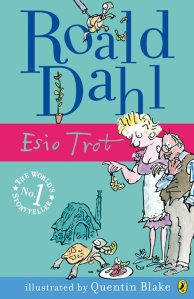
The BBC did a lovely adaptation of this last Christmas, which I re-watched on iPlayer the other day, and remembered that a while back, I’d been working through Roald Dahl’s books, but somewhere that fizzled out, and this is one I never read. Having finished another book this afternoon, this one I read in probably five minutes or less, but it’s lovely.
To be honest, I much preferred the book to the TV version, lovely as it was. The TV version added in unnecessary complications in the plot, and extra characters which I guess allowed them to lengthen it to 90min, but the concept is beautifully simple, and the book works wonderfully.
Mr Hoppy is in love with Mrs Silver who lives in the flat below him, but is too shy to tell her. When he finds out that she would just love her pet tortoise to grow a bit, he comes up with a plan to gradually swap him up in size, bit by bit over several weeks, while she thinks it’s the work of some magic words he’s given her – too cute!
Everyone who’s seen this book in my handbag or has heard I’m reading it has been raving about it, it’s definitely a book I read because of recommendations, because other than that not a lot drew me to it. But the recommend-ers were right 🙂
I definitely had a few issues with it, it runs as a series of lots of separate events and stories, but dips in and out of some and comes back to them, but only once you’ve forgotten what on earth was happening, which left me a tad confused. The other thing that confused me was how similar all the names were, but I guess maybe that was a more cultural thing? It just meant that when those characters popped up again later it took me a while to work out who they were.
All that said, it was very enjoyable, fairly light and an easy read. And master of the multi-sell, the last page definitely left me wanting to read the next one at some point (and the next one has giraffe in the title, which will nearly always win me over!). There are a tonne of books in this series, so it definitely won’t happen in one go what with my current to-read list, but I would definitely continue, so I guess that’s another recommendation for you right there!

Last week I was on Sunday School, but I’ve just found time to sit down and listen to the sermon.
“You shall not make for yourself an image in the form of anything in heaven above or on the earth beneath or in the waters below. You shall not bow down to them or worship them”
The first commandment forbids us from worshiping false gods. This one forbids us from worshipping the true God falsely.
The Rule – “You shall not make for yourself an image in the form of anything in heaven above or on the earth beneath or in the waters below.” – v4
This means man made representations of divine beings. They could still make things, but not to worship them – the verse continues “you shall not bow doen to them or worship them.” Nothing in the tabernacle represented God directly, the items were to aid worship, not to be worshipped. These days we have things like banners and the cross in church, they’re to help us worship.
The Reason – “for I the Lord your God am a jealous God” – v5a
God loves His people with a jealous love. Jealousy doesn’t get a good press, it’s often a negative thing these days, but in the bible it means that God burns with love for us. God loves us too much not to be jealous.
“A God who was not jealous… would be as contemptible as a husband who didn’t care whether or not his wife was faithful to him. Part of our problem with this profound covenantal reality is that we have come to regard religion, like everything else, as a matter of ‘consumer choice’… We resent monopolies. But the unique and incomparable, only living God makes necessarily exclusive claims and has the right to a monopoly on our love….Jealousy is God’s love protecting itself.” – Christopher Wright
He loves us, and wants to be loved in return.
The Warning – “punishing the children for the sin of the parents to the third and fourth generation of those who hate me” – v5b
Not many of us these days have carved idols at home, we have more of an issue with idols of the heart. An idol is anything we love or trust more than Jesus Christ.
The idea of punishing children for the sin of their ancestors is something that is very hard for us to understand in our individualistic western culture. In those days, three or four generations would have been likely to live together, and so if the head of the household worshipped idols, it would likely mean that the rest of the family would too. They worked in family units, not as individuals.
Discipline is part of love. It’s not loving to allow your children to do wrong and just let them get on with it and say it’s ok.
“because the Lord disciplines those he loves, as a father the son he delights in.” – Proverbs 3 v 12
The Promise – “but showing love to a thousand generations of those who love me and keep my commandments.” – v6
The promise is so much more powerful than the warning: 1000 >>>>> 3 or 4!
We know that children, grandchildren and so on have the ability to make their own decision and turn away, but Grace is available.
What kind of legacy are we leaving? Will it be a blessing?
This still applies today
“The human heart is a perpetual factory of idols” – John Calvin
As Christians there are even more subtle ways we manage to make idols. Any time we try to make God into something we can contain or control we’re making an idol. We may try to bargain – “If I do this for God he will do that for me”, or think there are formulaic ways to get God to answer prayer.
We make an idol when we choose to worship God for some of his attributes but not others. For example, we’re happy with a compassionate God, but less keen on a God who keeps us accountable for our sin. We shouldn’t ever want to water God down, that’s putting Him in our image. “Who wants to worship a God made in mans image?” – Julian Barnes
Rather than making God in our image, we need to be made in His. Adam and Eve twisted His image in us, and Jesus came to restore it.
Gradually catching up, these are my notes from last Sunday from the sermon on the first commandment:
“You shall have no other gods before me.”
John 14 v 6 comes straight from the first commandment: “Jesus answered, ‘I am the way and the truth and the life. No one comes to the Father except through me.”
Our culture is suspicious of exclusive truth claims.
The book and film “Life of Pi” follow a boy who manages to commit to three of the worlds main religions, at different times, but never giving any of them up. He says:
“”Bapu Gandhi said, ‘All religions are true.’ I just want to love God,” I blurted out, and looked down, red in the face.”
Only in the west is it deemed arrogant to say that only your religion is correct. To say they’re equal is arrogant itself.
Religious freedom is good, but pluralism takes that to saying that you can’t say yours is true for any religion.
Tolerance and respect are good things, but you need to be able to offer your faith to others.
The government wants to Ofsted church groups – we may be penalised for making truth claims.
This isn’t just an issue in this day and age. The Egyptians were worshipping just about everything, with the Israelites caught in the middle of it all.
God demands the exclusive worship of His people.
We could take this commandment to read that long as God is number 1, then you can still have other gods below Him. But we aren’t to worship any other gods in the presence of God, and we can’t escape His presence!
There are risks of us worshipping all sorts of things, including: wealth, comfort, control, sexuality, power career, family, heath, fitness, leisure, pleasure and food. These can all be good things, but any good thing can be an idol if it pushes God out of the centre.
“He answered, ‘“Love the Lord your God with ALL your heart and with ALL your soul and with ALL your strength and with ALL your mind”” – Luke 10 v 27a
Who or what do we love? Do we mean it when we sing “Jesus, we love you”? Try some diagnostic questions:
Behind al false gods we serve is the God of self. “To love oneself is the beginning of a lifelong romance” – Oscar Wilde
The solution is to fall in love with God again and again and again. No one else is worthy.
“There is actually no such thing as atheism. There is no such thing as not worshipping. Everybody worships. The only choice we get is what to worship.” – David Foster Wallace
“Turn your eyes upon Jesus,
Look full in His wonderful face,
And the things of earth will grow strangely dim,
In the light of His glory and grace.”
Some of the most AWFUL things people have done to their Sims – ‘scuse the language
J K Rowling’s brilliant revenge on Stephen Fry


It’s been a long time since I’ve written up my sermon notes from church. Partly due to being on so many rotas on Sunday mornings I haven’t often been able to take any, and partly because I just keep falling asleep on Sunday afternoons. That said, we’ve just started a great new series on The Ten Commandments, and I’ve been in church for the first 2 sermons (an intro, and then the first commandment) so I thought I’d see if I could get back into routine. (and you can listen to any of the sermons in the series as they get uploaded, here)
So for week one we had an introduction to the whole topic, and the reading was Exodus 20 vv 1-17, all 10 commandments!
“Written in Stone”
A society created around choosing the bits we want and leaving the rest is what the book and film “The Stepford Wives” was based on. We can’t just choose the rules we want and ignore the rest, or we’d just have a “Stepford God”

Gilmore Girls “plotholes” – some are more just observations than plotholes…
How well do you know Ross Gellar’s freakouts?


