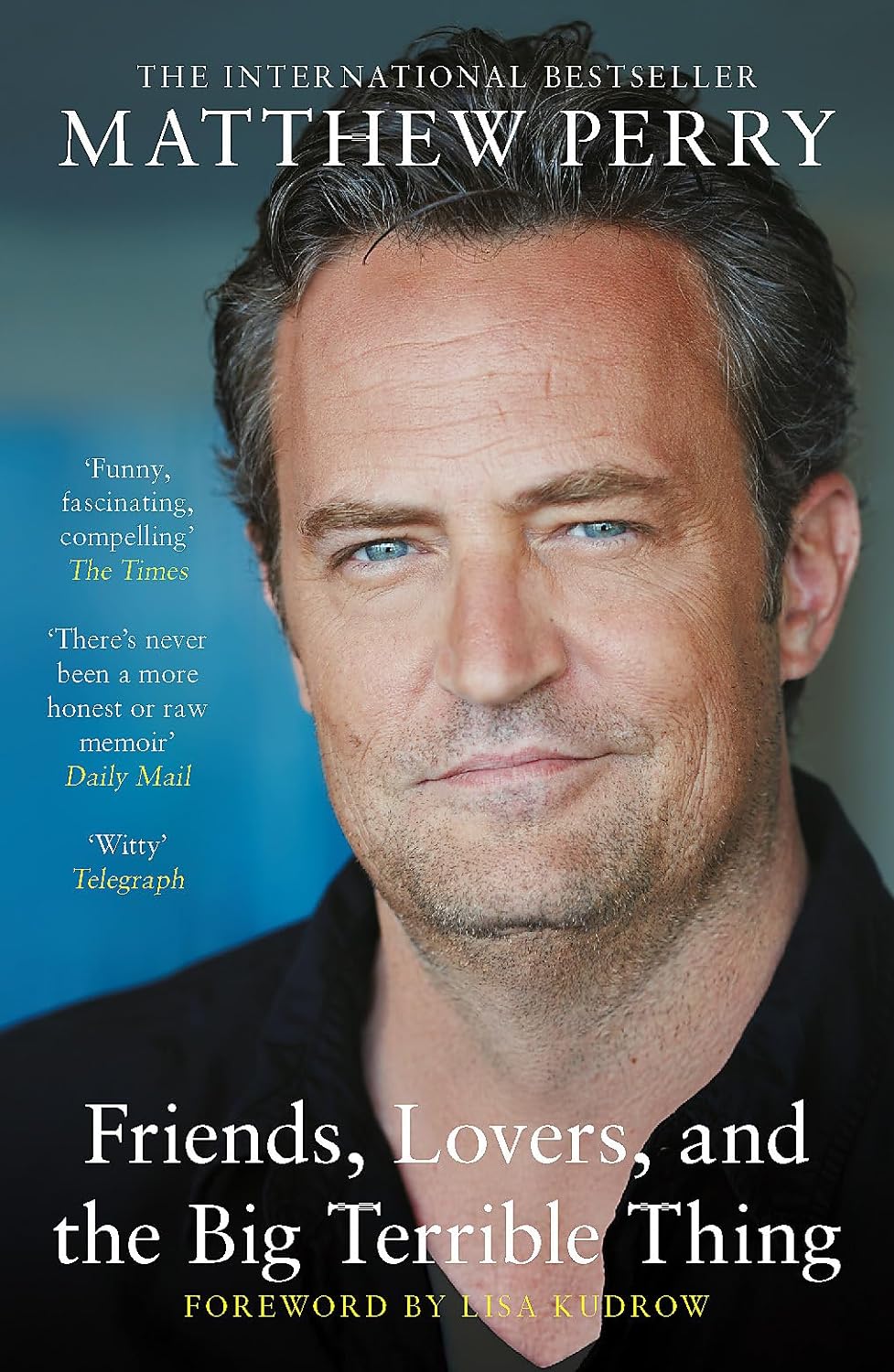
This was such a sad book to read, but I guess it’d be foolish to expect otherwise. It was published in 2022 in hardback, but he died in 2023, and so when the paperback came out this year, while the content of the book is the same, the “about the author” is in the past tense, and that alone broke my heart a little, but it doesn’t get much easier once the book starts. (I’ll be sharing more about the content of this book than I normally do, because it’s not exactly a spoiler to say life was hard for him!)
- In the foreword by Lisa Kudrow, she finishes by saying, “He has survived impossible odds, but I had no idea how many times he almost didn’t make it. I’m glad you’re here, Matty. Good for you. I love you.” – the heart breaks a little more.
- Then the prologue starts, “Hi, my name is Matthew, although you may know me by another name. My friends call me Matty. And I should be dead. If you like, you can consider what you’re about to read to be a message from the beyond, my beyond.” – I mean, really, he had no idea how quickly that became true.
- In chapter one he says, “It is very odd to live in a world where if you died, it would shock people but surprise no one.” – just so accurate for how we felt that day.
A big theme of the book is the problems he had with addiction for most of his life, and we hear how at a month old, he was given barbiturates for colic for a month, and he obviously wonders how much it all has to do with that. At one point as an adult he’s up to 55 Vicodin a day among other things, he names all sorts of drugs that I’d never even heard of before. He tells us that over his life he spent about $7million just trying to get sober, and we hear a lot about that struggle too.
He talks about the women he’s loved with such affection, sadly most of these relationships seem to end because he’s scared, or doesn’t want to bring them down into what he’s dealing with – but remarkably he remained friends with several of them. He also talks about his desire to have children, and knowing that it never happened makes it so sad to read.
He also speaks about God a LOT more than I expected, including a prayer in 1994, not long before he got cast in Friends of “God, you can do whatever you want to me. Just please make me famous.”, then later, an experience he had of God’s presence in his kitchen when at one of his lowest points, and many of mentions of his sureness of God’s existence throughout. I’d seen articles referencing this in the past but never got around to reading them – I will now be going back to see what they have to say (here and here if you’re interested).
He talks about his weight fluctuation when on Friends: “You can track the trajectory of my addiction if you gauge my weight from season to season – when I’m carrying weight, it’s alcohol; when I’m skinny, it’s pills. When I have a goatee, it’s lots of pills.” He states that he was never high when they filmed it, but was hungover sometimes. Season 9 was the only season he was sober for the entirety of.
Towards the end of the book is where it gets tough. If you’d been reading it when he was still alive, it would have been full of hope as he talks about how he’s managed to quit drugs, drinking and smoking, and shares his hopes for the future, for the second half of his life. But of course, those of us reading it now, know that wasn’t to be, and it just made it yet another heart-breaking section.
The only criticism I’d have of the book, and the reason I only gave it 4 stars, is that the structure of it makes it a bit tricky to follow the timeline. It’s a series of chapters which I think are in chronological order, but with interludes between each which could be from anywhen, and even in the chapters, I’m not convinced he doesn’t sometimes flashback. Just a mention of a year here or there would be helpful. I mean, when he talks about Friends he does sometimes mention the series we’re at at that point, but maybe just something at the start of each chapter so you know how far time has moved on, and where we are, would have made me feel a little less lost at times. One story I think he told twice, but once in the prologue and once much later on when it fit in the timeline, and I guess he told different parts of it more the second time, either way, felt a bit odd.
While it was a sad book to read, it was easy to read as far as flying through it goes.
I’ve used the words “sad” and “heart-breaking” so many times in this post, but even so, I’m glad I read this book.



 ineke.co.uk